Two Women on Living with Chamberlain
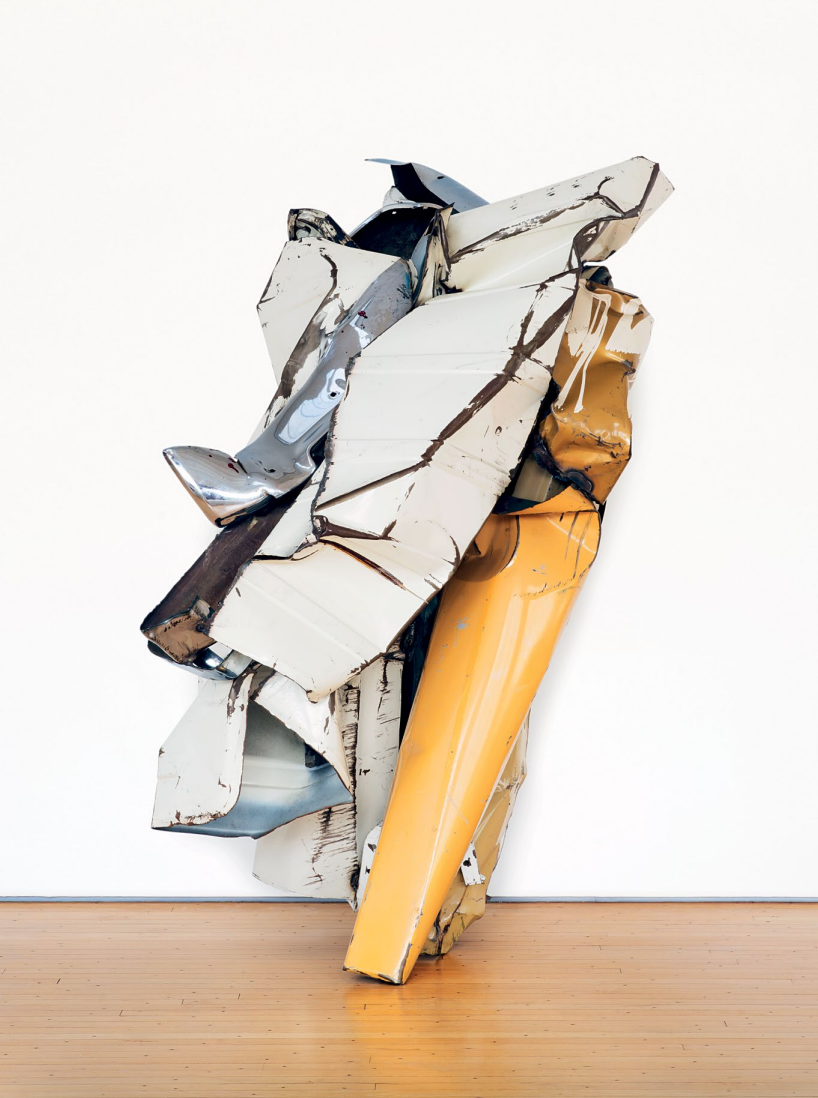
John Chamberlain, The Hot Lady from Bristol, 1979, painted and chromium-plated steel, 83 x 51 x 50 in., Dia Art Foundation, 1980.
Alexandra Fairweather and Yvonne Force Villareal
Two Women on Living with Chamberlain
By Bonnie Langedijk
Alexandra Fairweather and Yvonne Force Villareal met at a dinner for the launch of Living with Chamberlain: Art in Residence at the Lowell Hotel. A fitting place for two women whose lives intersect through one of the most daring sculptors of the 20th century. Fairweather, Chamberlain’s stepdaughter, grew up in a world shaped by his restless creativity, surrounded by the sculptures and spontaneous adventures that defined his life. Force Villareal, a collector and cultural entrepreneur, lives with one of his iconic sculptural couches, a piece that not only anchors her home but also tells the story of how she met her husband, artist Leo Villareal.
As Director of the John Chamberlain Estate, Fairweather preserves the artist’s legacy while expanding its reach. She oversees conservation, archives, and exhibitions, ensuring that Chamberlain’s work continues to inspire new audiences. For Force Villareal, the work of living with and commissioning art has always been about connection and context. Through her co-founding of the Art Production Fund and Culture Corps, the respected art advisor and entrepreneur has turned ambitious projects like Prada Marfa and Ugo Rondinone’s Seven Magic Mountains into cultural landmarks. Bringing art to wide audiences while maintaining a deeply personal relationship with each piece.
In this conversation, Fairweather and Force Villareal explore what it means to live with Chamberlain. Through the home, through public art, and through the enduring influence of his work. From personal anecdotes to reflections on artistic legacy, the two women discuss how Chamberlain’s work continues to shape the ways we see, experience, and inhabit art today.
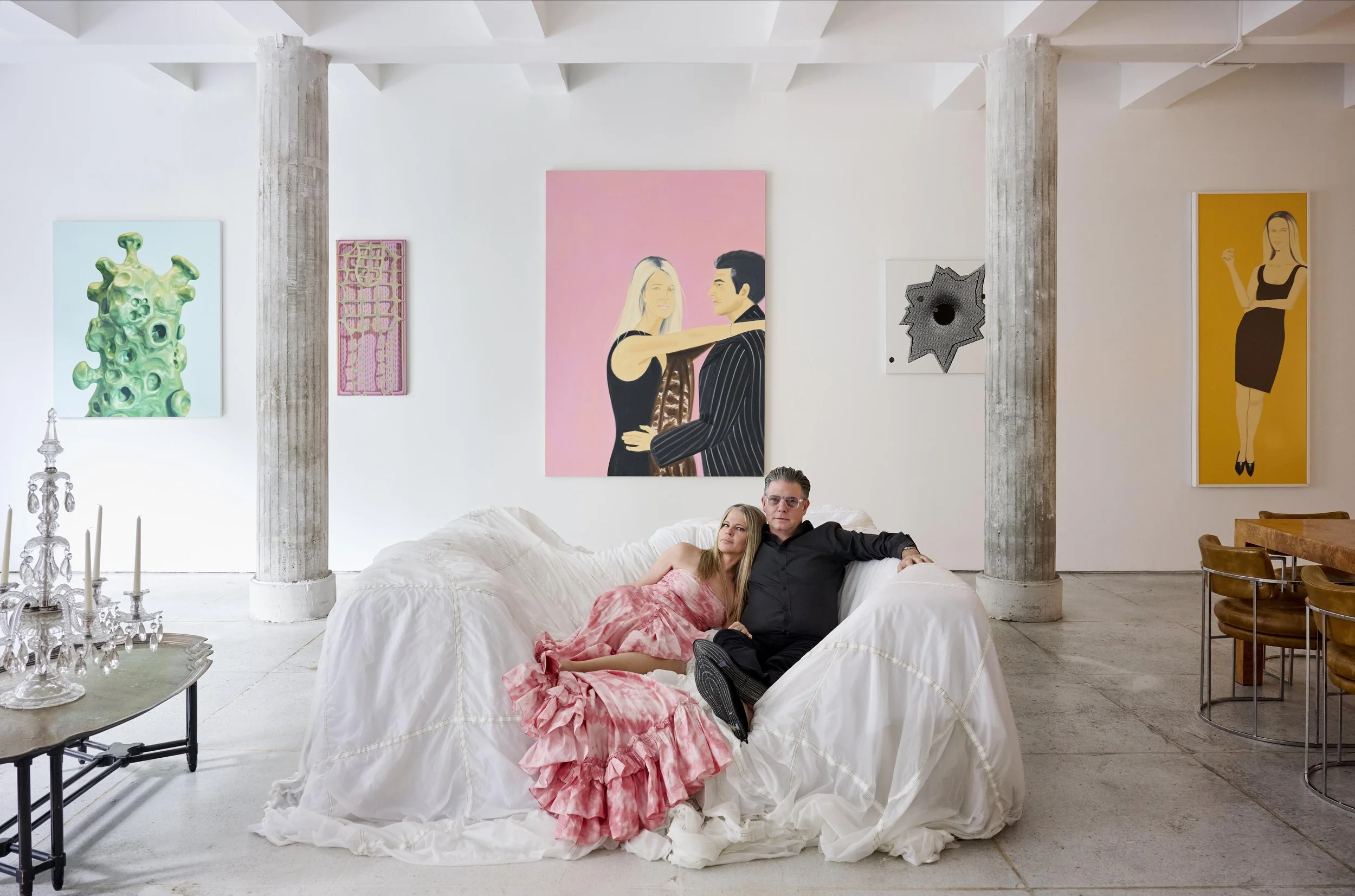
Yvonne Force and Leo Villareal sitting on their Chamberlain foam couch in their home in New York City, 2024.
Alexandra: Did you ever meet Chamberlain in person?
Yvonne: Yes, I met him in 1994. I was the assistant director at a gallery called A/D (Artist/Designer). We commissioned functional objects by artists and also reflected on this tradition through curated shows. For example, I organized one about historic artist-designed tables that included Mapplethorpe, Rauschenberg, and Méret Oppenheim, among others. We also did very specific commissions like Turrell dishware and Tuttle chandeliers. I was a gallerina before the word existed! We also represented Donald Judd Furniture. Judd and Chamberlain had a great relationship and history with each other. For three years I sat on a Judd chair. I can't say it was the best thing for my posture, but, you know, I was in my twenties. We had several of the couches and barges before we did the Chamberlain exhibition, where I acquired one, after 1995. When I worked there, he came in several times, but I officially met him in 1994 at Pace Gallery in SoHo at an exhibition titled John Chamberlain: Recent Sculpture.
Alexandra: I also loved learning about how you met Leo [Villareal]. Could you tell that story?
Yvonne: Yes. I met his father a few months earlier in Guadalajara at an art fair. A woman who was working at A/D with me, Sarah Vanderlip, would always talk about Leo. When I met his father, he referred to him as Leopoldo Villareal. I came back from Guadalajara and asked Sarah, "Who is this Leopoldo?” And she said, “That's my friend Leo.” So we were destined to meet and we were kind of set up by both of them. We met at the John Chamberlain opening at A/D, standing over the couch that is now in our living room—the one that is part of our love story together. I acquired the hand carved prototype, and Leo acquired one of the editions made from that prototype. We ended up with two John Chamberlain couches for double the fun.
“For three years I sat on a Judd chair. I can't say it was the best thing for my posture, but, you know, I was in my twenties. We had SEVERAL of the couches and barges before we did the Chamberlain exhibition, where I acquired one, after 1995.”
Alexandra: Do you have this type of connection or history with other pieces in your collection?
Yvonne: I do. Our collection is very personal and there are two works that are deeply meaningful in a similar way. One is a 1995 painting by Lisa Yuskavage. It's called Blonde Brunette and Redhead. I met her in 1995. She wasn't well known yet. A young dealer told me I should go see her work. When I walked into her studio I was blown away, she was painting Blonde Brunette, and Redhead. I said to her, when you're done with that painting, I would love to potentially acquire it. I broke her record and bought that painting for $10,000 and it has hung on my wall ever since. It’s in dialogue with Ellsworth Kelly’s Red, Yellow, Blue, but she's using Laura Ashley colors, and it's about what the blonde, brunette and the redhead signify to her, and how these archetypes grow in her work. It's a foundational triptych for what unfolded to be an incredible painting career. She's also painted me many times, when my body has been in its most exaggerated forms during pregnancy and postpartum. The other artwork is by Alex Katz, a portrait titled Yvonne and Leo, painted in 2005. I've been modeling for Alex since 1992. He's painted me over 20 times. We were so grateful to buy this one from Pace Gallery. We paid for it in four installments. I'm thinking now—I met John Chamberlain at Pace, we bought that painting through Pace when Alex was showing there, and my husband now is represented by Pace. It's full circle.
Alexandra: It really is. It seems like the art world in the nineties was so much fun, especially at Pace.
Yvonne: I was talking about the nineties last night with Jay Jopling and Sarah Morris, the painter, at Ilana Savdie's opening at White Cube. We were reflecting on the nineties and how it was such a wide open territory. Unlike the eighties, the nineties weren’t documented as much. It was a kind of a portal where incredible things happened.
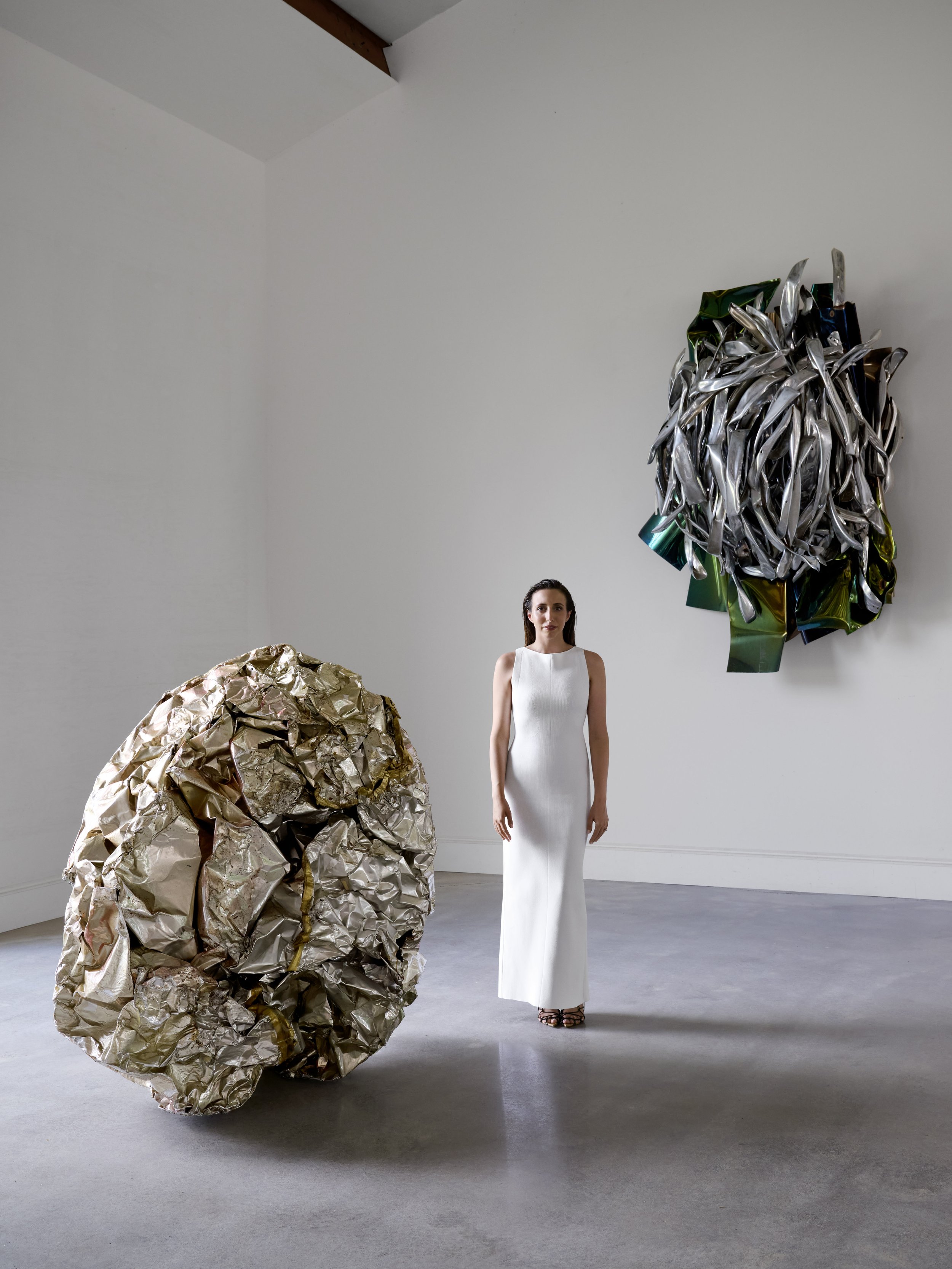
Alexandra Fairweather, photographed by Jason Schmidt.
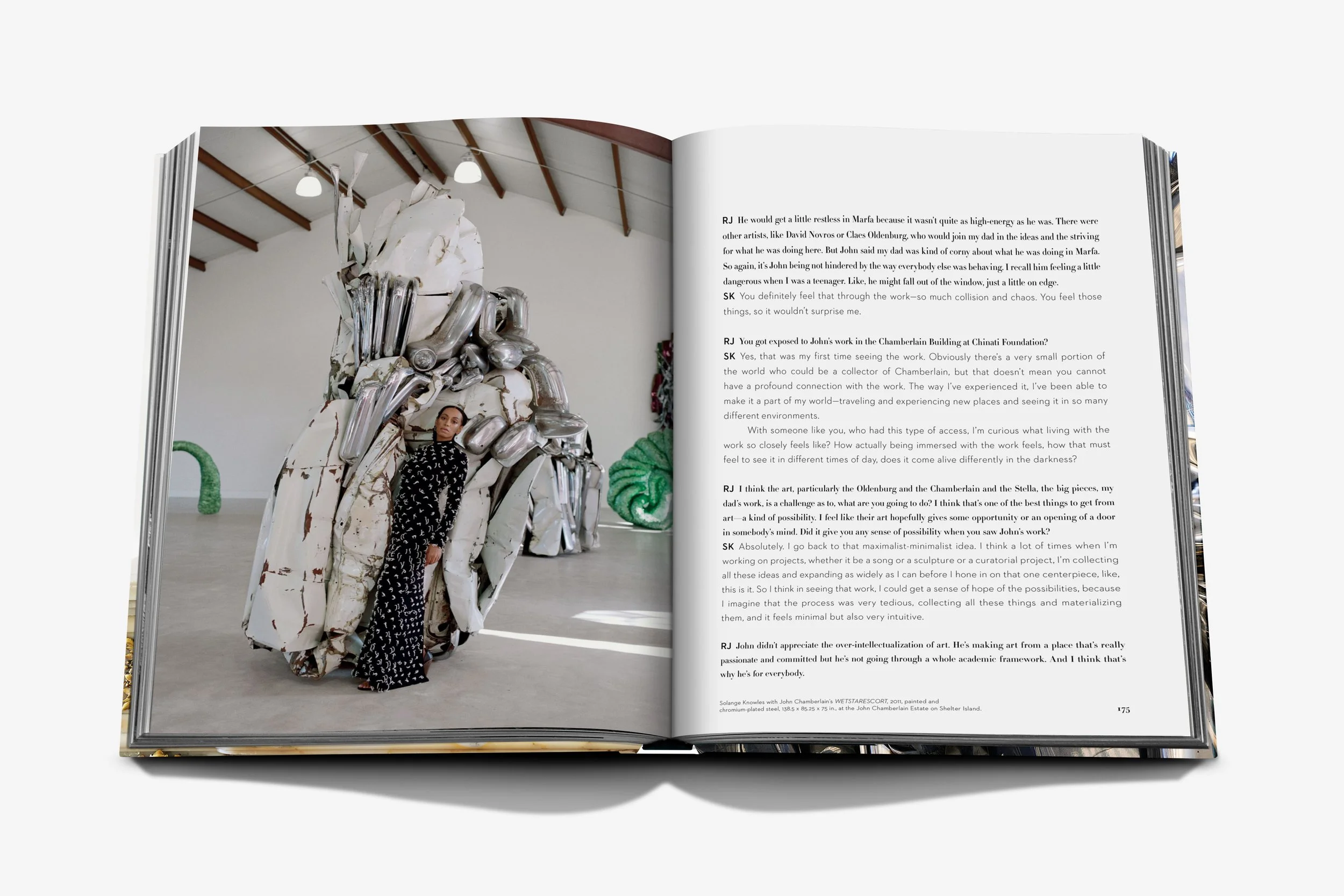
Outtake from the Living With Chamberlain book.
Alexandra: Your work with Culture Corps is so inspiring. Do you look for different qualities in the works to place in public or civic settings as opposed to private or even your own home?
Yvonne: We both understand the importance and the difference of living with art in your home, and the incredible responsibility of putting art within public settings. I think what sets me apart from other advisors or curators, is that my main focus has been on art within the public realm. When I co-founded Art Production Fund (APF) with Doreen Remen in 2000, the mission was to fulfill artists' dreams of making important public art and bringing it to very broad audiences. We ran APF for 17 years (and remain on the board of directors) and then went on to start Culture Corps, a curatorial consultancy. We work with corporate and private collections to enhance spaces with art. Many of our clients are developers that privately own public facing property where we have curated permanent large-scale artworks by artists such as Shilpa Gupta, Yinke Shinibare and Jeppe Hein. Our most recent project, commissioned by Related Ross in West Palm Beach, is titled Portals by the great Fred Eversley. It took over three years to create and was the last artwork before his passing—it was an incredible honor for Culture Corps to work with him on such an important sculpture.
Alexandra: That's amazing.
Yvonne: Art in public places needs to be inspiring for a child and also nourish an art historian. It should create awe, wonder, provoke contemplation and be a place people want to gather around, whether it's spontaneous or a planned pilgrimage. During my years at Art Production Fund, we commissioned iconic projects like Elmgreen & Dragset’s Prada Marfa in 2005 and Ugo Rondinone's Seven Magic Mountains in 2016. Now, I work with clients to curate private collections, and Leo and I have our own art collection, which is deeply personal. The difference is that the work in private spaces is a direct reflection of who you are and who you aspire to be. You build a relationship with the artists you bring into your home, even if you don't know them personally, and carry the responsibility to be the custodian of that work. There are some similarities in both, but there are also vast differences. Speaking of art in public spaces, I just went to Rockefeller Center.
Alexandra: What did you think?
Yvonne: Awe, provocation, contemplation—that’s what the Rockefeller Center installation brings. I know that you also did an installation at the Grand Palais earlier this year. Are these public exhibitions part of a larger initiative or mission?
Alexandra: We want to share Chamberlain's work with the generations of today. One thing that we've found, especially with working with the book, is how many he has inspired. I often think about Chamberlain's own story. When he was at the Art Institute of Chicago, he walked into the Giacometti room and he knew then he wanted to be a sculptor. You have millions of people walking in these public settings and you don't know how it's going to change someone's life in a fundamental way.
Yvonne: I was at Kennedy Yanko's opening at Salon 94 last month. She curated an exhibition featuring her own work as well as the work of artists who have had a major influence on her work that includes, of course, John Chamberlain. So yes, I see it, his influence. It's incredible how this book is solidifying Chamberlain's artistic legacy. What are the other qualities that you hope to safeguard and share through this publication?
Alexandra: I hope people will get a sense of who he was as a person. He wasn't defied by social constructs. I'm sure when you met him, you noticed how authentic he was too. Being an authentic person is really powerful. As you said, art can inspire you to become who you aspire to be, and when I look at Chamberlain's work, I think about how I can rethink my own life. How do I take that courage and that ability to experiment.

John Chamberlain, circa 1972, with self-portrait from 1948. Photo Neil Williams/Digital image © The Museum of Modern Art/Licensed by SCALA/Art Resource, NY

Courtesy of the John Chamberlain Estate.
Yvonne: I love that he created the soft sculpture and the hard sculpture. When we think about what his functional object sculptures do, they create a new relationship between people by placing them in an atypical way. You have this intimate cocoon that you get into and it just rearranges this straightforward sitting arrangement. That speaks a lot to what he has done in all of his work, provoking people to see things differently. You actually have a unique perspective on what it means to live with Chamberlain. What was it like having him as a constant presence in your life day to day?
Alexandra: It was never boring. He would wake up and he'd say, let's go to Paris today and we would go. Forget about packing. That kind of adventurous spirit and being so spontaneous is really freeing. To grow up with that is the greatest gift that I've ever had.
Yvonne: How did your mother meet him?
Alexandra: My mother was working for Dan Flavin. And after work, Dan and her were at The Laundry, which was a restaurant in the Hamptons in the nineties. Chamberlain walked in with his then girlfriend and he invited himself to join the table. Apparently it was love at first sight, but my mother was reluctant to get involved. For four years he went to every single Dan Flavin exhibition and kept following her. They were in Milan for Flavin's exhibition there, and he said, let's get lunch. And she agreed. They had this amazing romance. They had three weddings in one year all over. It was a special relationship to witness. They started dating when I was about two. They got married when I was six. I had a crib that Chamberlain made out of foam. That was when we were living at what was formally Elaine de Kooning's house in East Hampton. I really did feel like I was actually living in a Chamberlain.
This interview has been edited and condensed for clarity.
Shaniqwa Jarvis on why photographs are beautiful liars, grief as a portal, and the moment she found her whole practice hiding in a childhood snapshot.