When the Noise of the 'Now' Burns Out
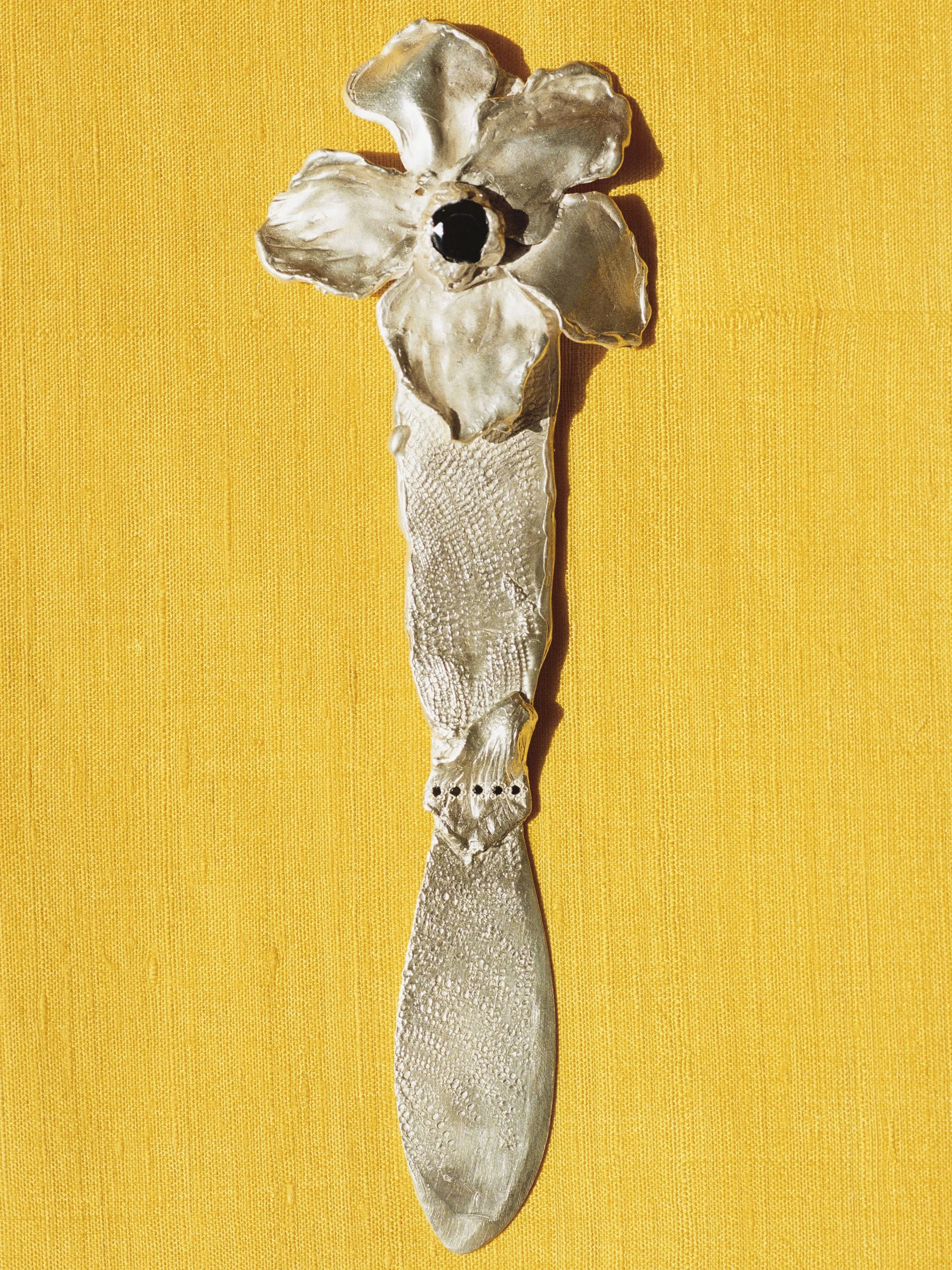
Elhanati x Conie Vallese. Courtesy of Elhanati.
When the Noise of the 'Now' Burns Out
To mark A Woman's Work at Basic.Space Los Angeles — a curated space by HURS showcasing furniture, design objects, and books made exclusively by women — we're speaking with the galleries and makers featured in our booth.
By Orit Elhanati
Milan Kundera wrote about the 'unbearable lightness of being', the idea that a life lived only once has no weight and no significance. I have always read that not as liberation, but as a warning. We are surrounded by the weightlessness of digital ghosts and evaporating trends, by objects designed to vanish the moment they are consumed. We live in a world of 'quick reading' where everything is flattened for easy digestion, and nothing is allowed to resist – consequence has become unfashionable. This modern obsession with lightness is a form of cultural cowardice. It suggests a life lived without a footprint, as if a soul could leave no mark on the earth.
For me, choosing depth is a refusal to be that light. It is the decision to stand by your own density without the desperate urge to explain yourself to a world that prefers the shallow. Depth is power. It is the only power that remains when the noise of the 'now' burns out.
I was a silent child, an observer. I spent years accumulating the weight of feelings I did not yet have the language to articulate. Even as a child I was drawn to the secret gravity of things, to spaces heavy with history and people who didn't talk just to fill the air. Lightness always felt like a lie to me, a temporary state for those afraid to leave a mark.
I have always collected memories as a way of grounding myself in a world where I didn't quite belong. Being a child of mixed heritage, never fully of the north or the south, became my primary strength. This lack of a singular home forced me to find home within the weight of my own existence. I carry the scent of places I have never been and the stories of lands I only know through instinct.
To me, spaces and environments function as portals rather than mere muses. When exhibiting in a space, I am not simply looking for a backdrop, but for the intelligence held within the walls. These historical spaces serve as gravity wells where the stories of the past can settle, providing a physical knowledge that the mind has not yet translated. I seek to enter these environments as a witness to their transformation, allowing the objects I display to become part of rituals and stories that have existed long before us.
Thirteen years ago, I made a ring. It was the first true object I ever created, and it wasn't a design in the way people think of it now, it was more of a reaction. I took a raw, jagged rock I found in the Sinai desert and used it to create a ring that would outlive both you and me. At the time the industry looked at that ring and saw a mistake. They saw something too heavy, too 'un-jewellery' and too aggressive, and told me it wouldn't sell. I kept it anyway.
Today, over a decade later, that ring remains unchanged on my finger. The trends that were deemed 'essential' then have been buried and forgotten three times over, but the Rock Ring persists. It has outlived the whims of fashion because it wasn't built on a trend; it was built on conviction. It is the silent witness to my entire career, a reminder that if you build something with enough weight, time cannot touch it. This is the kingly position: to be the one thing that stays while everything else moves.
I often feel that I am not so much a designer as I am a witness to a transformation. I'll keep a piece of gold or a half-formed object near me for weeks or even months. I live with it and I watch it. I carry the idea until I can no longer justify its excess, and only then do I begin the work of stripping it back. I carve toward the core to remove every excess gesture and every drop of sentimentality.
If a piece is trying too hard to be 'beautiful', I destroy it. I seek resistance in the material because if the gold gives in too easily, it has no soul. There is an absolute honesty in the flame. You cannot pretend when the material is pushing back against your hands, and you can almost see my fingerprints in the metal because I was there.
To me decoration is a hollow word when it is separated from meaning. Historically, ornament was never just for show, it was armour and protection. It was a ritual you performed when you put it on your body to face the world. A bowl was not just a vessel but a place where the energy of a room could settle. I refuse the hierarchy that calls this work 'secondary' because I am interested in the object as a biological necessity, like something you wear because you would feel exposed without it. There is a fundamental difference between decorating a space and adding weight to it. Decorating adds noise, weight concentrates truth. One is a distraction of the eye, the other is a compression of the soul.
I am creating for the body and the space it inhabits rather than for a mirror. A piece of jewellery should shift your posture and an object in a room should shift the energy of the air. They should make you aware of the curve of your neck, the strength of your shoulders and the ground beneath your feet. The physical world has an intelligence that the mind hasn't touched yet, it understands proportion instinctively. It feels the truth of an object before language can interfere. When you surround yourself with things that have weight, you are anchored. You are no longer floating in the frantic, shallow time we inhabit. You are forced to be present, and you are forced to feel the pull of your own existence.
True depth requires duration, a refusal to be consumed by the quick read of the modern era. Consider the experience of standing before The Last Supper. The painting does not change, the woman who stands before it does. Each decade, she brings a new density of experience, and the work becomes a mirror for her own internal growth. This is the power of things that stay; they provide a fixed point that allows us to measure the depth of the marks we leave behind.
Living in an era of quick readability means everyone wants to 'get it' instantly, but depth requires the courage to be silent and the confidence to let the work exist without a caption. In the silence, the work becomes a mirror for our own depth. Silence is control. It is the refusal to be consumed by the 'now' and the confidence to exist without seeking a 'like'. The power of choosing depth is that you force the world to slow down to meet you. You become a person or an object that shifts the energy of a room just by existing. You aren't seeking to be liked, you are seeking to be felt.
There is a quiet, heavy strength in things that refuse to move. When an object has enough weight, it stops being a decoration and becomes a companion to your own presence. It is the raw sensation of touching a part of the earth that hasn't been thinned out by the noise of the world outside. This is a shared rebellion and a commitment to the weight of our own existence and the beauty of the things that stay. Lightness leaves the surface polished and polite – and forgettable, while depth demands the courage to be textured and real.
We are not remembered for how effortlessly, how lightly, we floated through life. We are remembered by the depth of the mark we leave behind.
Everyone is an expert now, and almost no one is. In her latest essay, Bonnie Langedijk asks how confidence came loose from competence, why we believe the ring light over the researcher, and whether real expertise can survive a culture that rewards speed over depth.