The Designer Who Turns Feeling Into Form
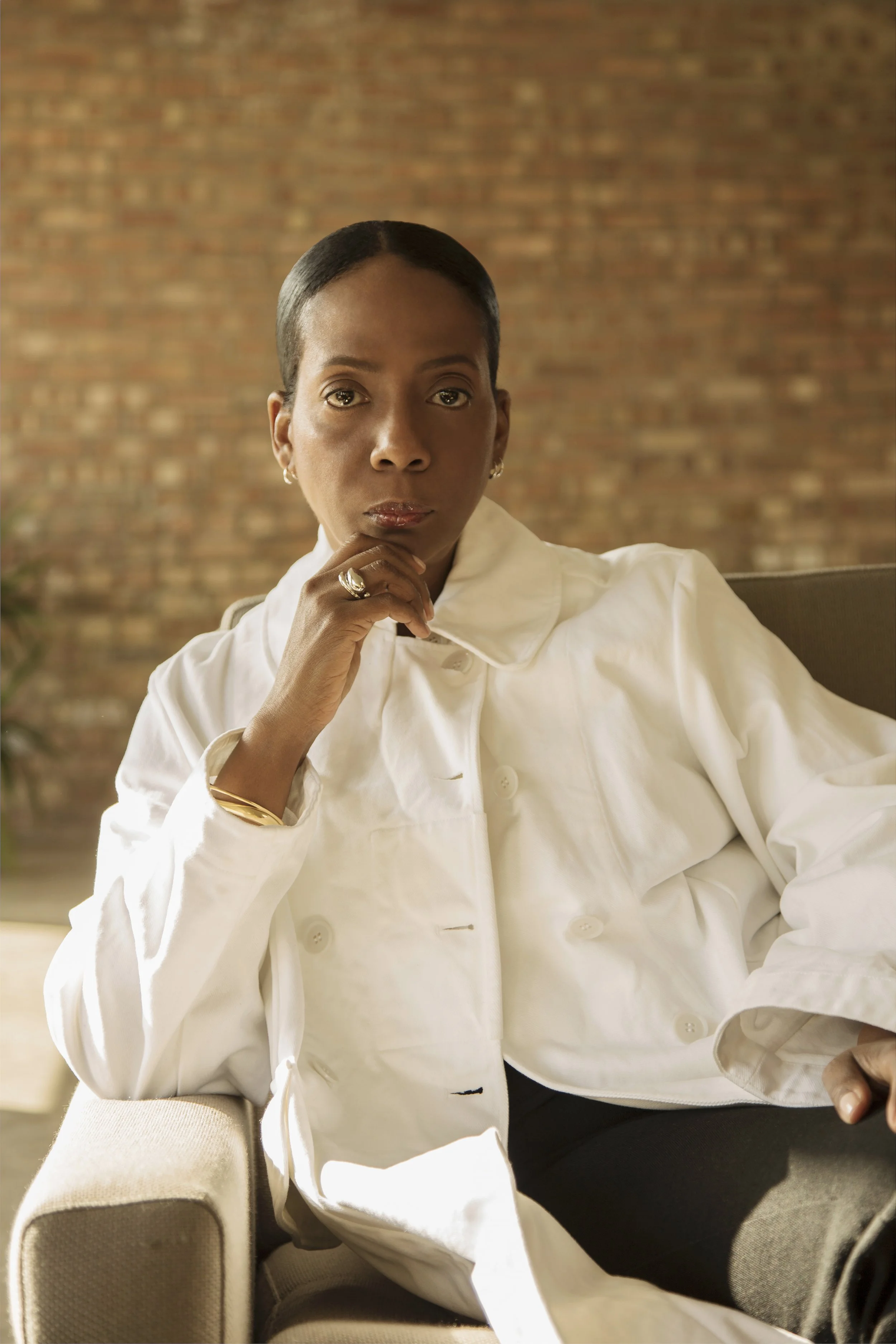
Courtesy of Jacqueline Rabun, photography by Thea Caroline Sneve Løvstad
Jacqueline Rabun
The Designer Who Turns Feeling Into Form
To mark A Woman's Work at Basic.Space Los Angeles — a curated space by HURS showcasing furniture, design objects, and books made exclusively by women — we're speaking with the galleries and makers featured in our booth.
By Bonnie Langedijk
The first piece of jewellery Jacqueline Rabun ever made was picked up by Barneys. The self-taught jewellery designer had just arrived in London from Los Angeles. What followed came fast: 10 Corso Como and Colette stocked her work, Judy Blame bought pieces for Neneh Cherry, and Linda Evangelista wore her jewellery on the cover of Vogue.
By the mid-nineties, Rabun had built a name defined not by any single collection but by something harder to replicate: a distinct creative language and the ability to capture the human condition in objects. When she began collaborating with Georg Jensen in 1999, it was a natural fit. Her collections for the Danish house, among them Offspring and Mercy, have since become some of its most enduring.
What sets Rabun apart is her insistence on meaning. She speaks of jewellery as talisman, as protection, objects imbued with energy rather than simply engineered for beauty. Her references span African art, Japanese purity, Danish design, and surrealism, but the throughline is always human: how we experience loss, love, healing, and transformation, and how an object worn against the skin might hold some of that. In an industry that has become faster, louder, and increasingly driven by commercial logic, Rabun works at her own pace.
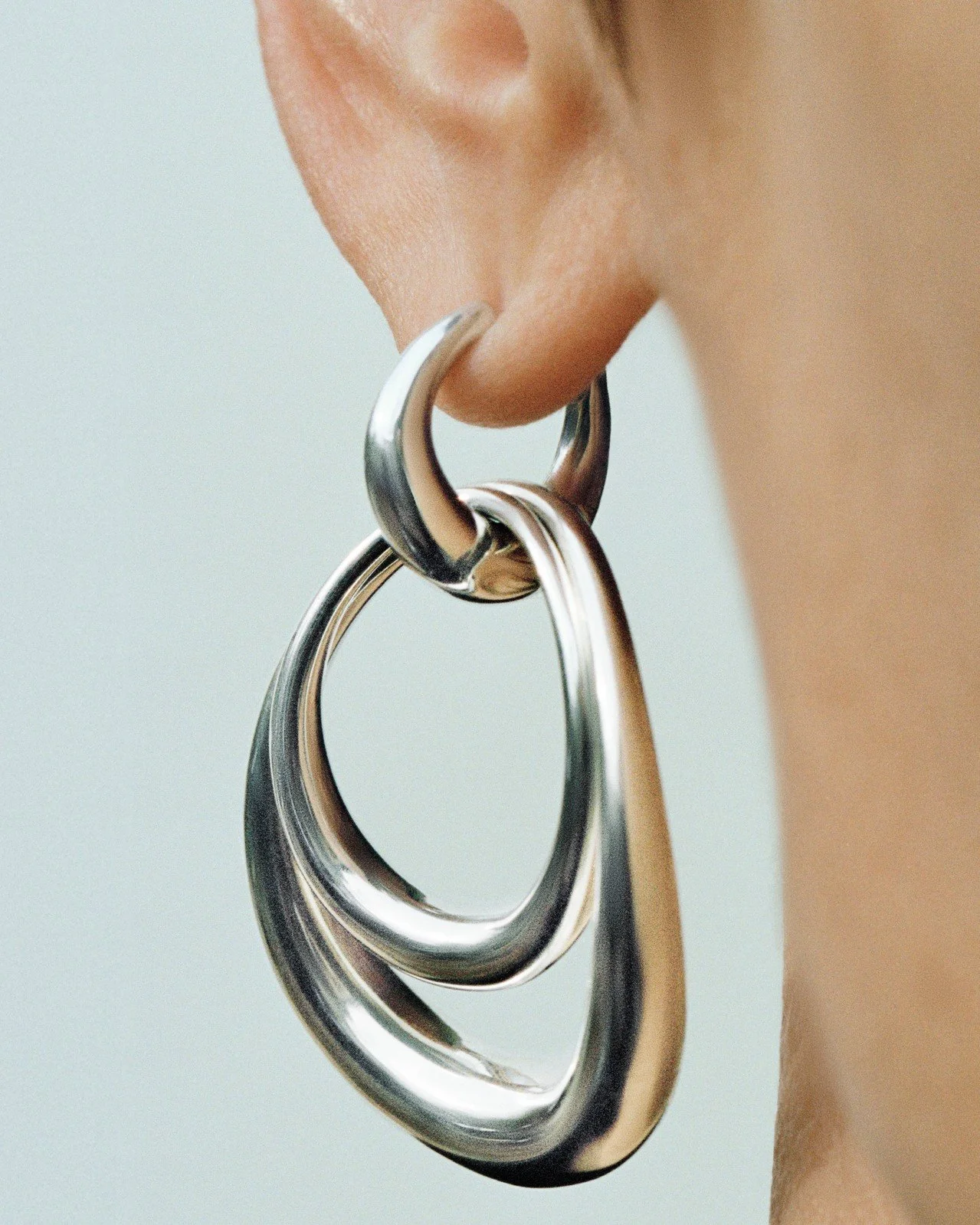
OFFSPRING Earring, Sterling Silver. Designed by Jacqueline Rabun, courtesy of Georg Jensen.
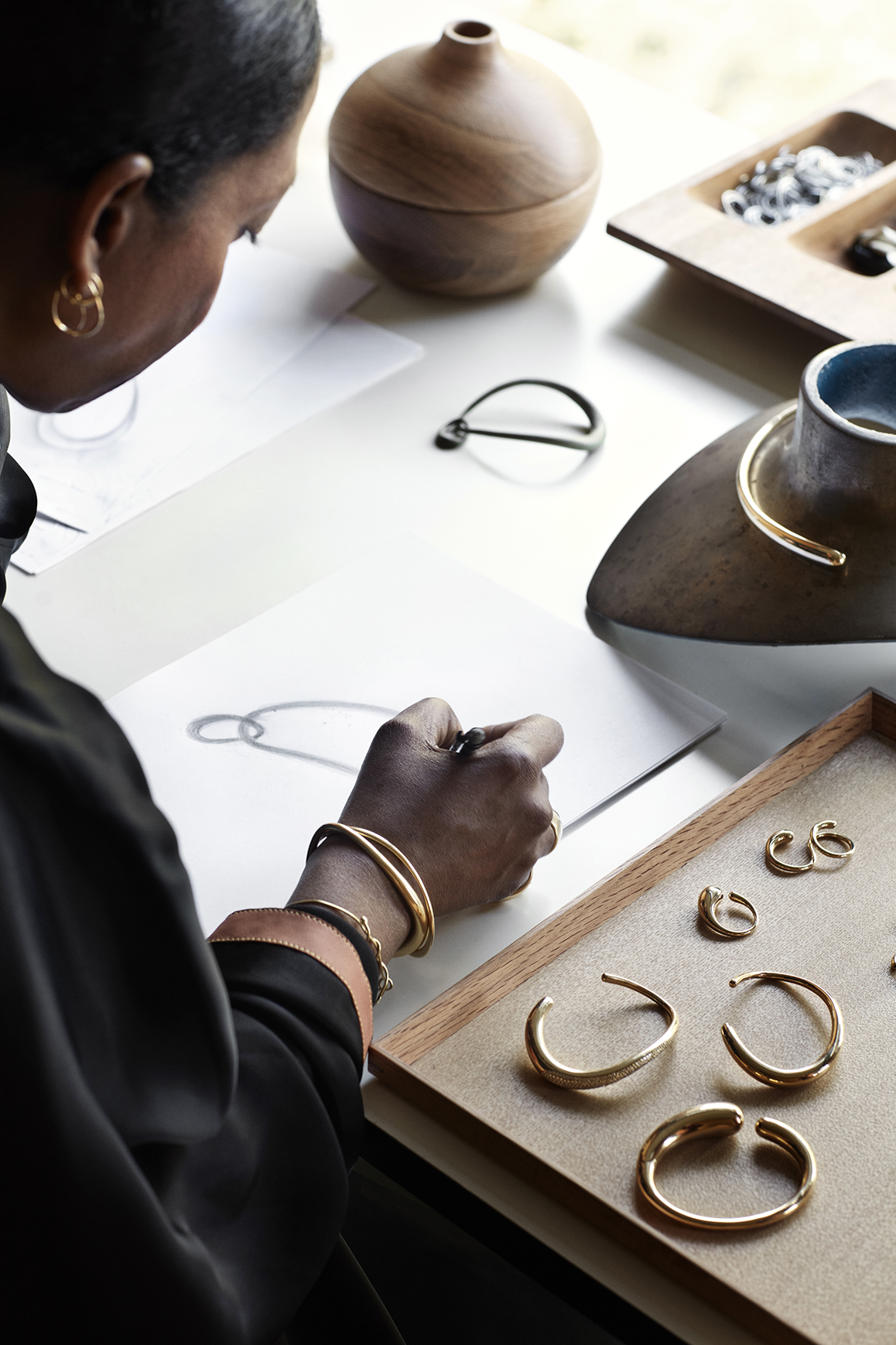
Jacqueline Rabun in her studio, photography by Line Klein.
How have you developed your distinct point of view?
It came very naturally. My work is a fusion of everything that resonates deeply with me.
What have been some of those key influences?
I am inspired by raw, organic forms found in African art, the expressive beauty of Danish design, and the purity of Japanese design. I also love surrealist art. I am drawn to modernist organic forms that complement the human body. I am deeply intrigued by the human experience—understanding the emotional challenges we go through, and how we accept, overcome, and heal from them. This is what I am truly passionate about, and it informs my design practice. Staying true to it feels natural when you follow what genuinely resonates.
There’s a tendency to try to define or categorise art and design. How would you describe your own creative practice?
I see my practice as a fusion of art and design. My process is organic and intuitive—I like to think of myself as a channel. I feel free to create in any medium that speaks to me.
“I am deeply intrigued by the HUMAN experience—understanding the emotional challenges we go through, and how we accept, overcome, and heal from them.”
You weave deeply personal narratives into your collections. Is there one that’s especially meaningful to you?
The Offspring collection, which I designed in collaboration with Georg Jensen, is very special to me. It was inspired by my own journey through motherhood and the unbreakable bond we share with our children. The egg form—an important symbol in my practice—represents birth, creation, and continuity.
As you imbue these pieces with meaning, do you think about how the wearer feels?
My intention is to imbue my work with healing and positive energy, a quiet force that resonates with the wearer. We are living in deeply challenging times energetically, and I believe talismans are more important than ever as a source of protection.
How would you describe your creative process? Is it different when designing for yourself in comparison to designing for a brand?
My process is very meditative. Ideas often come at unexpected moments—it’s a deep knowing when a design is ready to move from a drawing into a three-dimensional form, and then out into the world. I am a perfectionist, so it can take time to arrive at the right form. My process remains essentially the same when working with Georg Jensen, though it exists alongside a commercial framework—one that brings its own considerations.
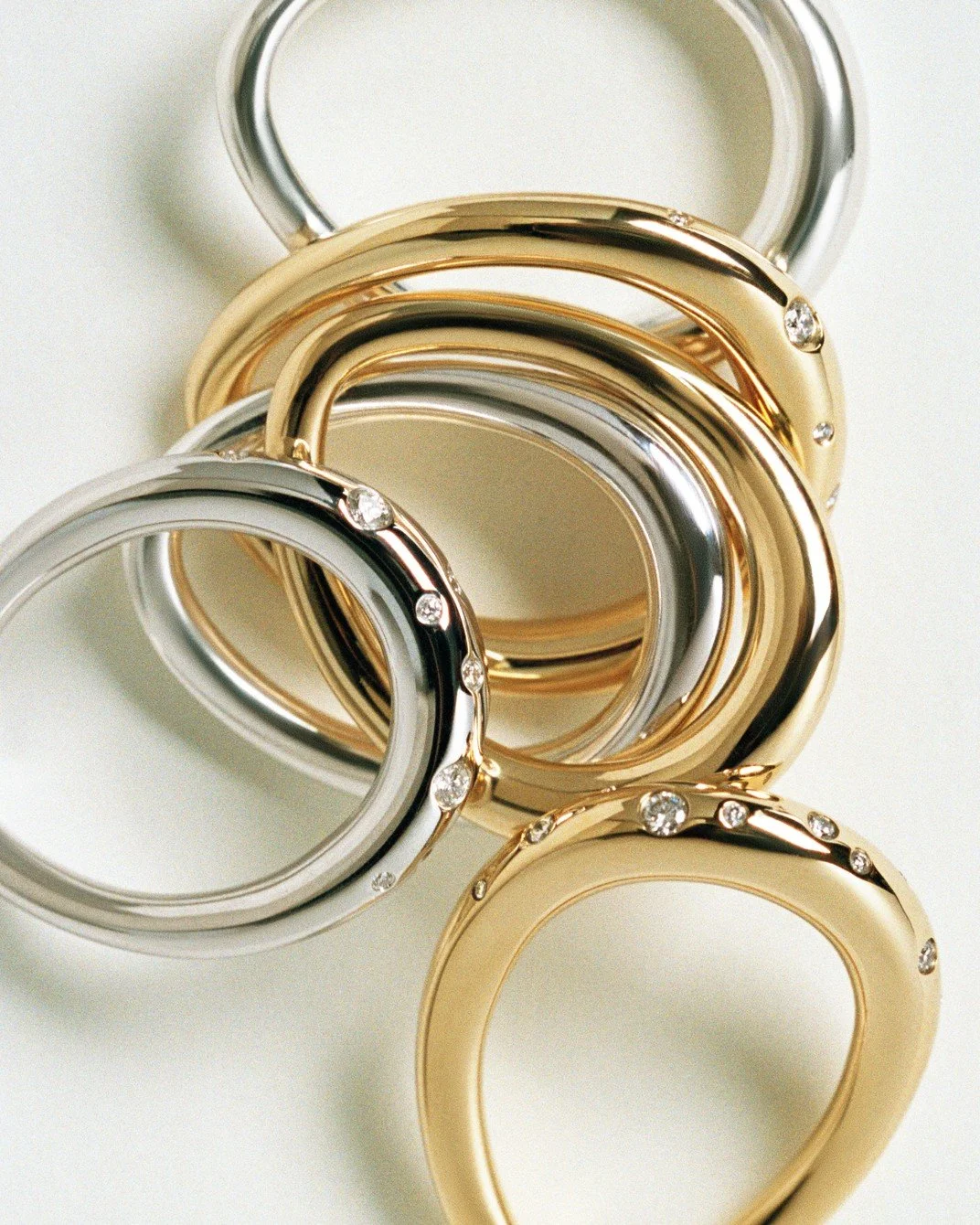
OFFSPRING Rings, 18k Yellow Gold & Sterling Silver. Designed by Jacqueline Rabun, courtesy of Georg Jensen.
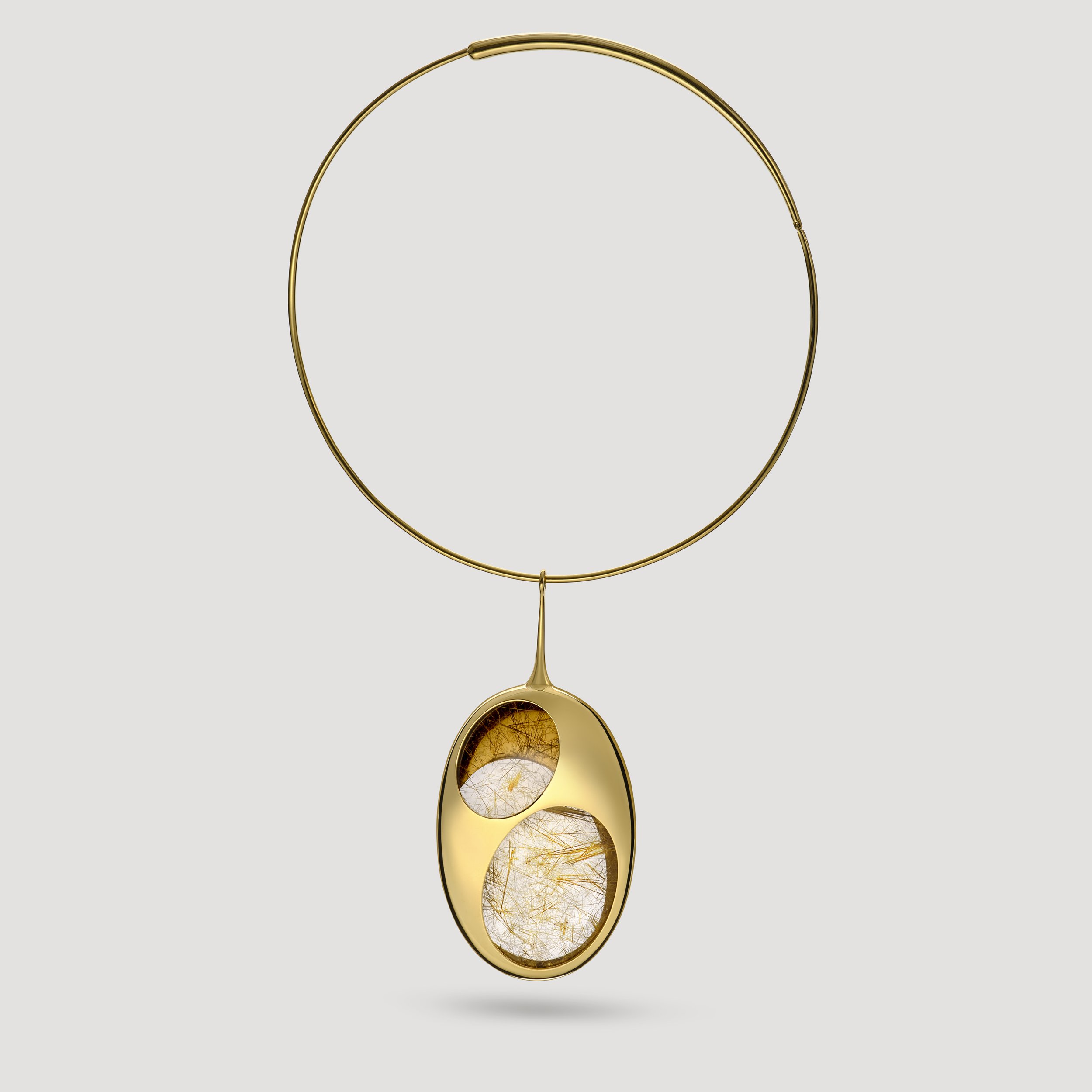
METANOIA, Torque, 18k Yellow Gold and Rutilated Quartz. Courtesy of Jacqueline Rabun and Carpenters Workshop Gallery.
You talk about the commercial framework when designing for Georg Jensen. For many artists, designers, commercialism remains a dirty word or a concept they don't want to be associated with. How do you relate to commercialism? And what's your approach to making something that fits within that framework?
I embrace the challenge of designing jewelry that exists at the intersection of art and commerce. My work often leans into bold, sculptural forms, allowing each piece to be perceived both as a wearable object and as a work of art. I see this balance as a discipline—almost a fine art in itself—to create something that functions commercially while remaining deeply expressive and true to my vision.
Has your approach evolved over time? Do you design with someone specific in mind?
I have evolved as a person, and that naturally impacts what I create. I don’t design for a specific individual—it’s more about the energy of a person and how they move through the world.
Do you see a common thread among the women who collect your work?
There is often a shared sensibility—an appreciation for meaning, form, and emotional depth. They are typically drawn to pieces that resonate aesthetically and spiritually.
How do you distinguish between jewellery as an accessory and jewellery as art?
Jewellery as art is far more compelling to me. It carries meaning, intention, and emotional weight—it transcends adornment and becomes something deeply personal.
You moved back to Los Angeles a few years ago. How does place influence your work?
Place has a huge impact on my designs. While I live in Los Angeles, I continue to travel—it’s essential for me to stay inspired and to experience different cultures.
What is the biggest shift you’ve seen in the jewellery industry?
The industry has changed significantly since I began. There are many more independent jewellery designers today, and luxury brands are increasingly focusing on jewellery. I think we will see a greater emphasis on alternative materials in the future as the cost of precious metals continues to rise.
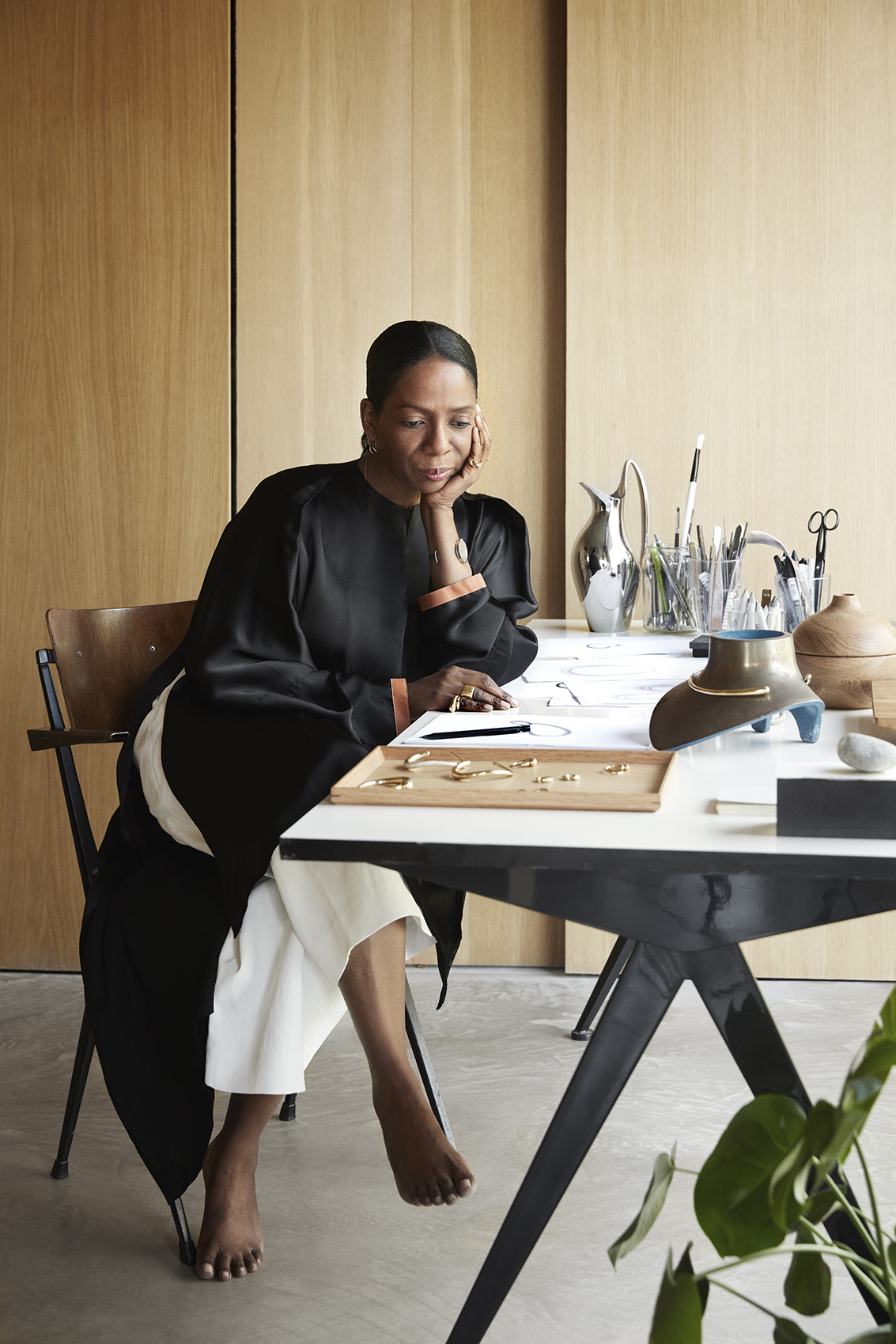
Jacqueline Rabun in her studio, photography by Line Klein.
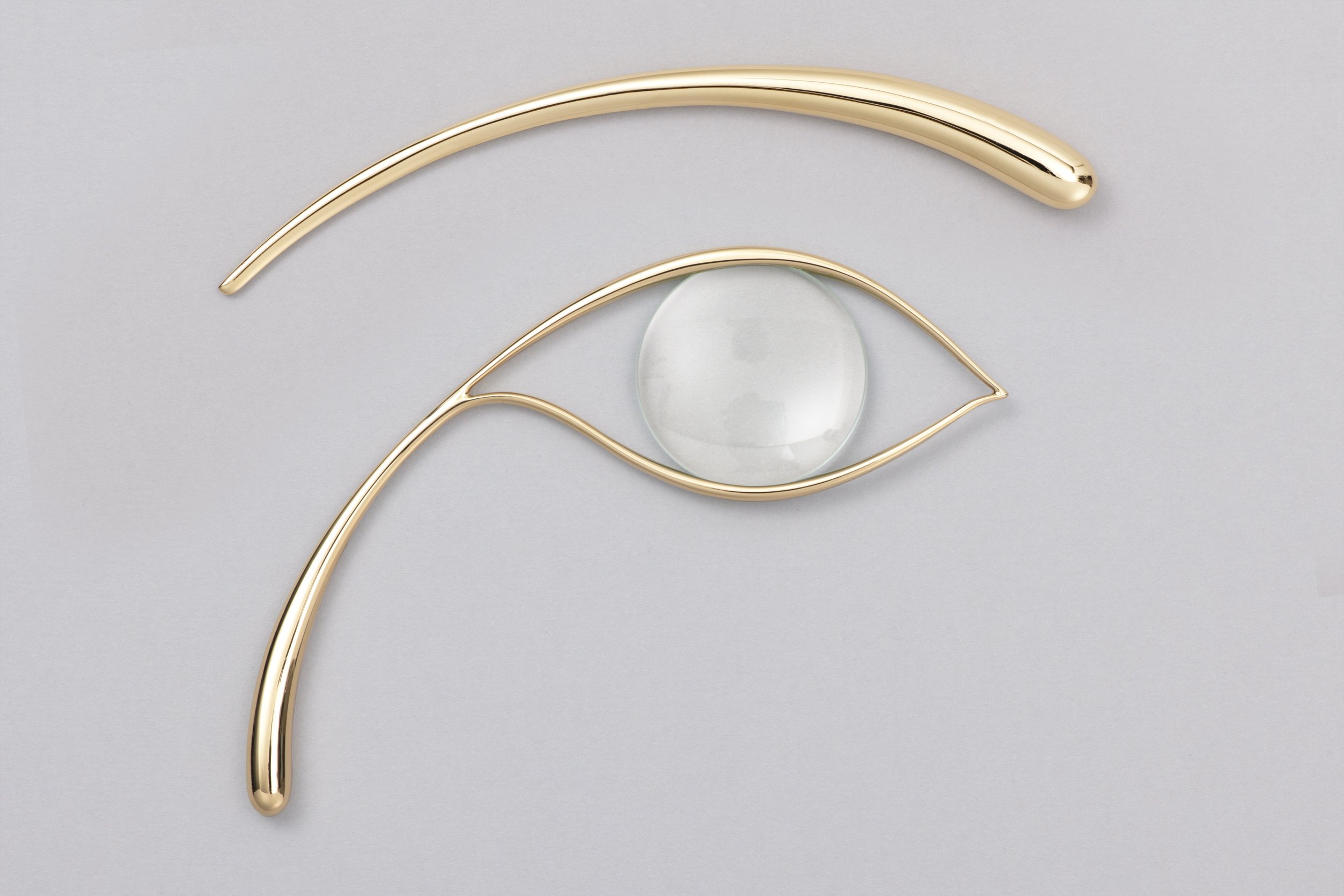
Look & Open, 18k yellow gold vermeil. Courtesy of Jacqueline Rabun.
With so many designers today, what does it take to stand out?
A strong, authentic point of view is essential, along with a distinct design language. It’s important to have something meaningful to say—and not to design for design sake.
Two of your pieces are featured in the HURS space during Basic.Space LA—can you tell us about them? The LOOK & OPEN magnifying glass and letter opener are inspired by the shape of my son’s eyes when he was a child. They are deeply personal objects, rooted in memory and observation.
How do you relate to the concept of “A Woman’s Work”? Do you think we’ve achieved equality in art and design?
Women have made significant contributions to design, particularly in terms of language and philosophy. However, there is still progress to be made—especially in industrial design, which remains largely male-dominated. I feel fortunate to collaborate with Georg Jensen, a company that has collaborated with extraordinary women such as Viviana Torun and Nanna Ditzel amongst others.
What needs to change? It feels like we’re at a crossroads for women’s rights.
Women are natural creators—we bring life into the world, and we are capable of anything we set our minds to. In many cases, it is the male ego that needs to evolve, as it can limit opportunities and visibility for women.
How do you view the role of women in the world today? Are there artists who have influenced your thinking?
This is a crucial time for women to be present in art and design. I admire women who have succeeded despite immense challenges—those who have faced adversity and transformed it into strength. Artists like Viviana Torun, Simone Leigh and Es Devlin are incredibly inspiring.
Has the perception of your work changed over time? And how do you view the current nostalgia for the 1990s?
I am deeply focused on my work, so I only occasionally step back to consider how it’s perceived. That said, there has been a growing sense of respect as I have continued to create and share my work with the world, for which I am truly grateful. I established my practice in London in the 1990s—it was an extraordinary time. There was a real sense of freedom, individuality, and creative expression without boundaries or commercial pressure. It was magnetic and the world was watching.
What excites you about the future?
I am curious to see how we evolve, especially as current power structures shift. I hope we will one day move toward a more balanced and conscious world—perhaps even a new kind of love revolution, reminiscent of the spirit of the 1970s. I remain hopeful.
This interview has been edited and condensed for clarity.
Shaniqwa Jarvis on why photographs are beautiful liars, grief as a portal, and the moment she found her whole practice hiding in a childhood snapshot.