A City Affair
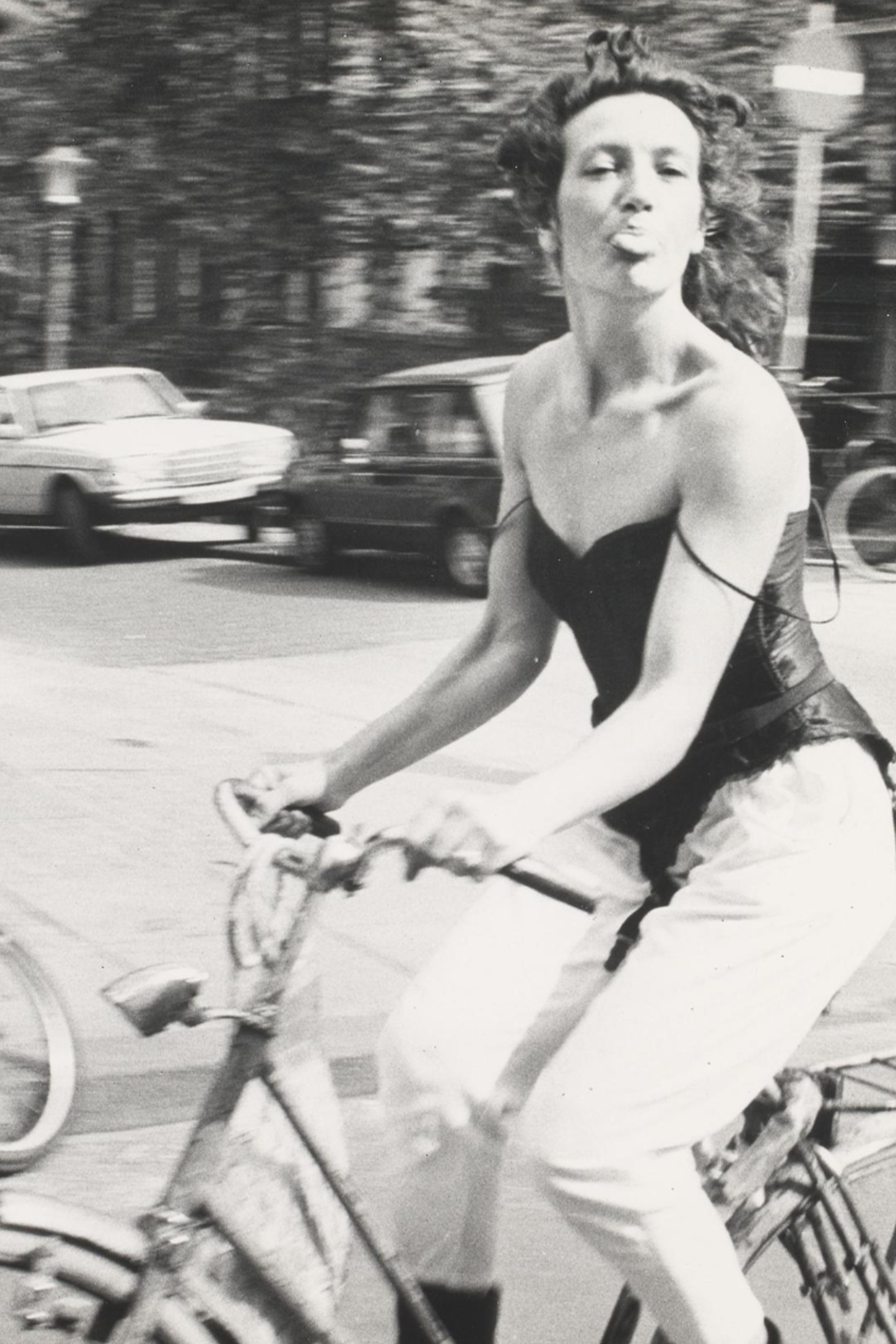
Ed van der Elsken, Woman cycling, Amsterdam, 1983. Rijksmuseum, Amsterdam. Gift by Anneke Hilhorst, Warder, 2019. © Ed van der Elsken estate/Nederlands Fotomuseum.
A City Affair
By Valerie van Maarschalkerwaart
As an urban cyclist you learn that the most liberating things in life tend to be the most dangerous at the same time. The other day, on my way to lunch, I had to cross the weird no-man's-land in front of Amsterdam Central Station, where cyclists, taxi drivers, tourists, junkies and drunken passers-by all cross paths — a place where people seem simultaneously lost and determined. A recipe for disaster. Yet the gentle spring breeze and shimmering water kept the mood cheerful. A woman in a purple suit stood at the intersection, holding a microphone through which she was spreading the word of God. A group of young adults stepped accidentally on her cardboard while searching for directions on their phones. An electric bike nearly ran them over before hastily swerving aside. I was listening to Miles Davis's "So What." It was in this chaotic, sunlit setting that I couldn't love my city more.
As this near-accident resolved itself, I was struck by how unnatural a living environment the city actually is — a made-up world on pile foundations, where all these different people converge in a small square breathing polluted air. Yet it is precisely this improbable place that gives the rarest kinds of people room to grow. Photographer Ed van der Elsken was a master at finding just those examples in his beloved, postwar Amsterdam. "It's anarchy, freedom, a mess, fine filth, old junk, crazy junk. It's disorganized, unregulated. Everyone is just messing around a bit," says Van der Elsken's voice in his film In Love Amsterdam. It could just as easily describe my bike ride — or Fran Lebowitz's observations about New York. Van der Elsken understood how to turn the metropolis into a stage: one that is always in motion.
A stage on which everybody carries their own mission. "We live in a world of people moved by strange, conflicted, poorly comprehended and above all devious motivations," Joan Didion writes in her famous essay The White Album. To her, California was a place uniquely attuned to disaster. I wondered how attuned to disaster I was, putting myself at risk daily on a bike in a city that lies below sea level. Or why people choose to live in places with such looming dangers at all.
“Like wildfires, earthquakes, and the threat of the Santa Ana winds force people in Los Angeles to adapt, participating in GENTRIFICATION becomes a form of survival in concrete. No one wants gentrification — yet there I was, about to order a negroni with green olives on a wooden bench in one of these very new-old cafés.”
Fran Lebowitz, the unstoppable sarcastic New Yorker, calls her city the one place where people are smart enough to know how dumb they are. She was one of them when the economic prosperity of the eighties sent people scrambling for apartments and working extra hours to pay for them. Like wildfires, earthquakes, and the threat of the Santa Ana winds force people in Los Angeles to adapt, participating in gentrification becomes a form of survival in concrete. No one wants gentrification — yet there I was, about to order a negroni with green olives on a wooden bench in one of these very new-old cafés. I know the essence of life can't be found in the buying of things, but I feel forced to defend myself that way, trapped by the uncomfortable feeling of wanting and not wanting at the same time.
That discomfort runs through all three of them, in different registers. Van der Elsken's camera, which once found joy in the spontaneous and the rebellious, now caught archetypes in squatters' movement T-shirts — some people still waving or sticking out their tongues or middle fingers at his lens, but with a different energy beneath it. Lebowitz, less fond of texts on sweaters, absorbed that new wave in her own way: in Social Studies she chronicles the challenge of finding something more than a two-bedroom Manhattan apartment that looks like a furnished palace, all while watching the city transform around her. Didion, meanwhile, positioned herself almost outside the city, reporting from the "freak-death" page of the LA Times on bizarre tragedies, car crashes and unsolved murders. Despite all of it, the looming dangers, the looming politics, she still noticed the details. An emerald green or gold dress. Embroidery. The hairstyle of a woman on page three. The short silk wedding dress she bought on the day Kennedy died.
Measuring the water level, the Richter scale, even house prices — what Didion calls the quantification of living — gives the illusion of personal control over these unnatural, impermanent spaces. It is the illusion of certainty in a life destabilized by its very nature. It's not only urban wisdom that opposites attract. But it is in the metropolis where those opposites are greatest: the dangers, and the beauty of the mundane, side by side.
That lunch I was heading towards didn't end until dinner. By then we'd become friends with the waiter, been given extra snacks by the staff, and received shots from the host, whom my companion had met at an afterparty. Lebowitz would have approved. Even though she mocks everybody, her commentary is always against the not-having-fun part. To her, the real prestige is in living itself. She would have awarded that afternoon a gold medal — though the risk lies in what this narrative leaves unchallenged. Living in the city at our age comes at a price, and it's paid by waking up at seven in the morning rather than still being awake. It's the blind spot for the darker side of urban growth.
The actual courage it takes to live in a metropolis shows in the ability to find the details that make life sparkle. This morning, when someone shouted at me on my bike for daydreaming at a green light, I could only imagine his morning: the coffee spilled on a freshly ironed shirt, the flat tire, his roommate's bike he had to borrow, a job interview he was already late for. Despite the winds — economic or atmospheric — that make a city shift, quake or expand, whether the Santa Ana or a housing boom, the city still offers grace.
I cycled home blissfully, crossing paths again with the woman in the purple suit — still unbothered by shame or the indifference of passers-by. I had to wait for a bridge to close before I could continue. And there I saw them. The girl with the nose ring and short hair. A guy in cowboy boots, leather jacket, long hair. A very rare Vivienne Westwood necklace. Two runners in mismatched football shirts. Even in full economic prosperity, with all the forward-moving winds, the city stops moving forward in front of an open bridge. I noticed the clouds — that no matter how dark they are, are always beautiful. A moment of standing still, where the people actually move.
That's the narrative I tell myself in order to live. It's what Didion, Van der Elsken and Lebowitz each saw in their own corners of the street: the metropolis as the perfect setting where life happens, simply by our shared force to coexist. My city. Your city. A love affair.

Everyone is an expert now, and almost no one is. In her latest essay, Bonnie Langedijk asks how confidence came loose from competence, why we believe the ring light over the researcher, and whether real expertise can survive a culture that rewards speed over depth.