In HUR Levi’s: Juliana Salazar
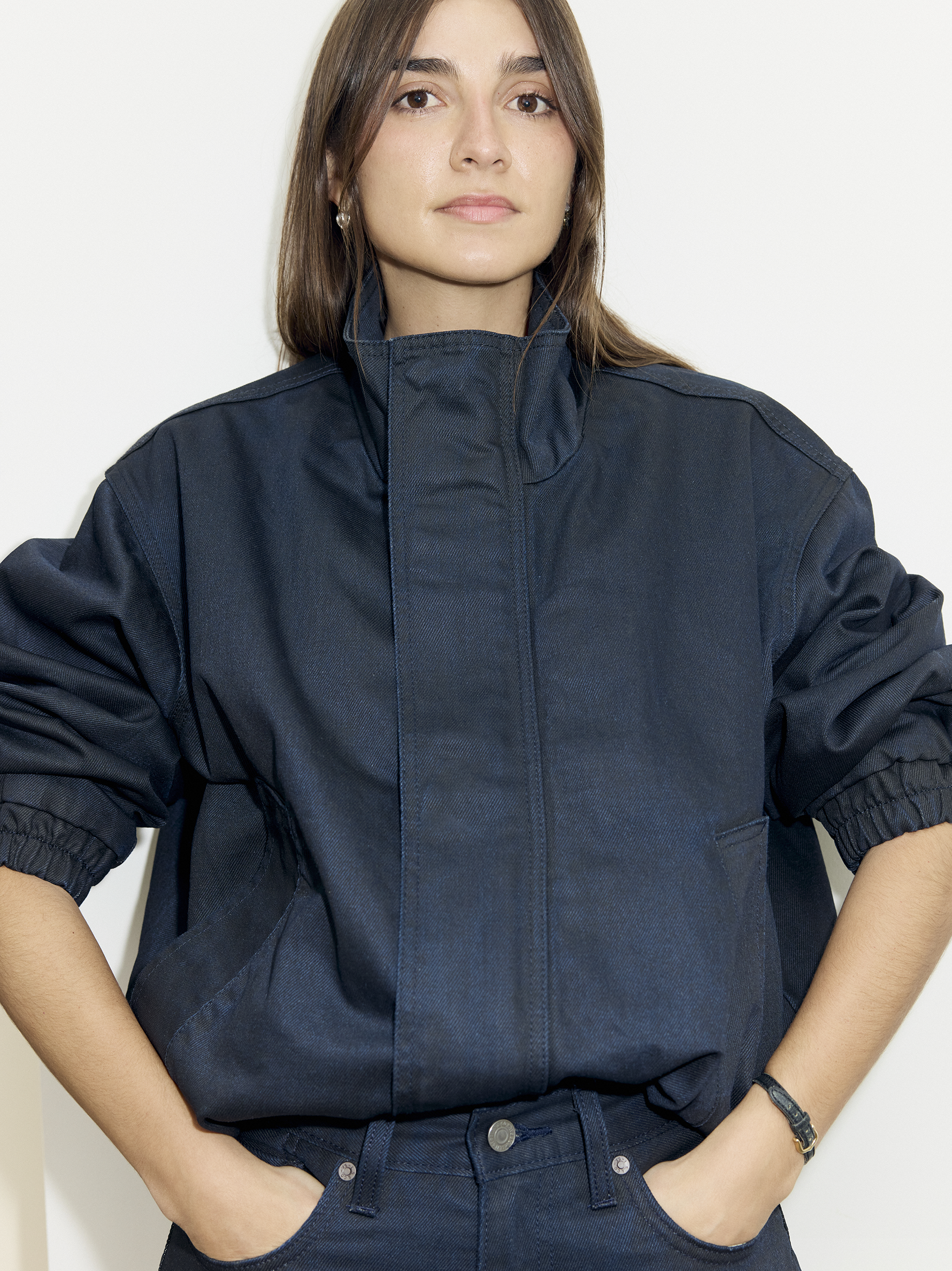
Juliana Salazar wears the Highland Park Jacket and 578 Baggy Jeans. Photography by Georgia Devey Smith. Courtesy of HURS.
Juliana Salazar
There’s no doubt Levi’s jeans are a classic—worn by icons throughout history. But what makes an icon today? And what’s changed in how they wear their Levi’s? We speak with 5 modern day icons—women who lead where culture goes next—in their favourite Levi’s fit.
In partnership with Levi’s®
By Bonnie Langedijk
Juliana Salazar is the person brands call when they want to matter. She made Ganni a cult phenomenon in America in six months. She's styled for Comme Si and Aimé Leon Dore, consulted for Nike and Ghia, and built a reputation for making luxury feel practical, never precious. She buys things to wear into the ground, pairs the ordinary with the unexpected, and protects her point of view by creating space for quiet. At 30-something, she moves seamlessly between styling, strategy, and creative direction—connecting brands to modern consumers without any of the gimmicks.
How do you think the idea of the icon has changed in your lifetime?
I think the idea is very much in flux. Andy Warhol’s idea of everyone having their 15 minutes of fame, it really feels like we've lived through the peak of that. Growing up, people were famous because of merit or some sort of nobility, whereas now you could be famous for quite literally anything and it can be quite fleeting and not necessarily good. I am being reminded of that meme that says “make famous people meaningful again”. Unfortunately I think value systems— morals in general, really— and the idea of merit have deteriorated. It’s disheartening that our media has made so many things and people that shouldn’t be important, important.
What makes someone an icon?
It's so subjective nowadays but to me it is someone who is a game changer. People whose impact stands the test of time.
If you've worked with someone who is considered an icon, do you still see them that way regardless of the proximity?
I think some people are so special that it’s literally palpable. Virgil for example, he radiated so much positive energy and a magnetism, that’s hard to dismiss. As I get older and meet or become friends with more and more people I think are iconic— it’s just sort of normal? It’s not like oh wow they’re an icon and they’re over here and I’m over there— the proximity feels natural but it is also special and I think it’s important to not become desensitized to that. I’m thankful that I have not met someone I considered an icon and they turned out to be a nightmare or something like that.
Are there women, past or present, you consider icons and what do they teach us now?
I just listened to a podcast with Donna Langley, and I thought, wow, she's such a badass. Can’t believe I didn’t know about her sooner. And then Jane Goodall. More contemporary I would say Charlie XCX. It might sound a bit weird to say because she's so of the moment, but I love her commitment to her authenticity, her craft and just who she is. She’s been on the periphery of fame for so long and she's just now kind of solidified her place as the talented creative she is. Definitely not a fleeting moment. She did some interviews where she said she was ready for her label to drop her, and she decided to do what she wanted to do and not try to cater to other people. That conviction. I find that very motivating. Who else? Ruth Bader Ginsburg.
“In fashion, everything is so QUICK, ever-changing and there's so much out there that it's nice when something cuts through the noise and people appreciate it for a longer time.”
Obviously an icon.
It's funny because most people would think about her because of her political impact, but actually her personal life is almost more admirable to me. She was in this amazing marriage and had a very full family life. Her partner was so supportive of her and not at all threatened by her. I think she had something that a lot of people really want, which is a full career without having to compromise on love or family.
What's interesting about classics or icons is how each generation rediscovers them anew. How do you feel about younger people encountering your work for the first time?
I'm always intrigued when people say they love my work. I always wonder: What work of mine do you love? I've done so many different things. Buying, marketing, creative direction, designing, styling— the work I've done with Nike, Ghia or Aimé Leon Dore are more easily perceived or understood. But I’m always curious as to what exactly resonates with others. Someone sent me a photo of a Comme Si shoot the other day—it was an image from the first campaign I did with them. I don't think they realized I worked on it. And I thought wow that’s really cool. Five years later and that image is still being used and I still like it. I think I feel equal parts bewildered and appreciative.
In such a visual world, it’s special for something to still resonate so far beyond the moment it was created.
Totally. Vogue did an article about the boxer trend and referenced my Comme Si work, and I think I was too burnt out at the time to realize how cool it was for my work to become the trend. And that it’s still relevant now. In fashion, everything is so quick, ever-changing and there's so much out there that it's nice when something cuts through the noise and people appreciate it for a longer time. You're constantly just doing things and you don't really think about them. But then when you've amassed all of these things, you're like, oh yeah, that's great or I've done well.
How do you make a classic piece yours?
I think wearing things in an unexpected way. I'm usually either sizing way up or down on something or I pair it with something that’s out of the ordinary. Even on my most boring or lazy days, I feel like there's always some detail that makes what I’m wearing my own. I think that’s embedded into who I am. For example, with shoes like these, I remember when I first got them, someone was like, that's such a silly purchase. You're rarely going to wear them. I was younger and It was definitely a big purchase, but now I’m on my second pair, because I wore them to the fucking ground. I would even wear them to Pilates with my Pilates socks.
I love that.
I'm not precious about clothes. I didn't grow up being able to shop a lot. My dad always says that jeans shouldn't cost more than $20. My parents don’t really get it and so when I buy something, it’s really intentional, and I'm wearing it to its death. I'm kind of known for that. And I definitely always have some sort of jewel or sparkly thing, like my Crocs are bejeweled. I like to add something that's a little funky and weird.
What about the jeans you're wearing? Why this pair, and is there a specific fit you gravitate towards?
I had actually tried these on a few days before randomly. I love that they're relaxed, but they're also put together. They're not sloppy slouchy, but they sort of just hang with a good stiff shape.
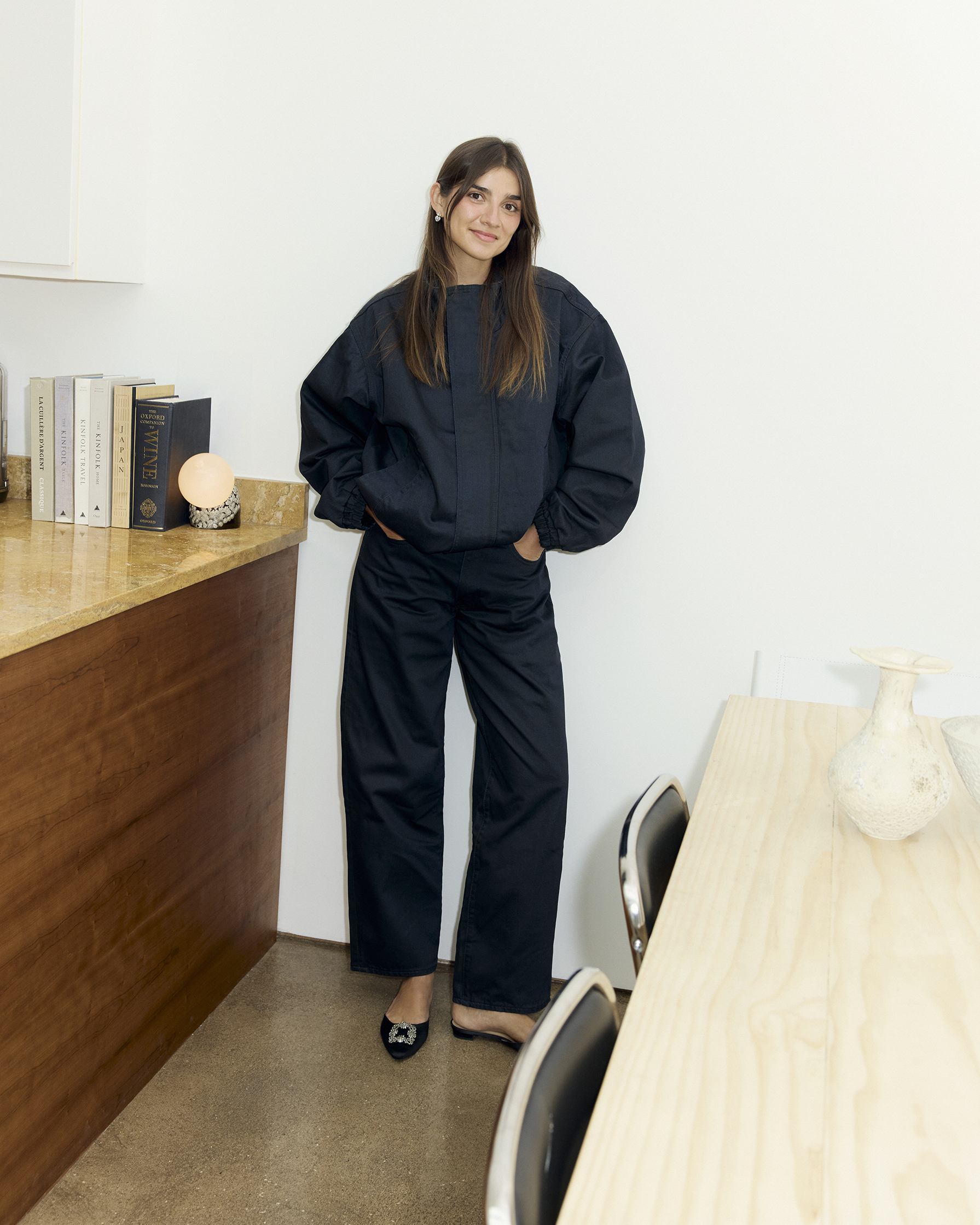
Juliana Salazar wears the Highland Park Jacket and 578 Baggy Jeans. Photography by Georgia Devey Smith. Courtesy of HURS.
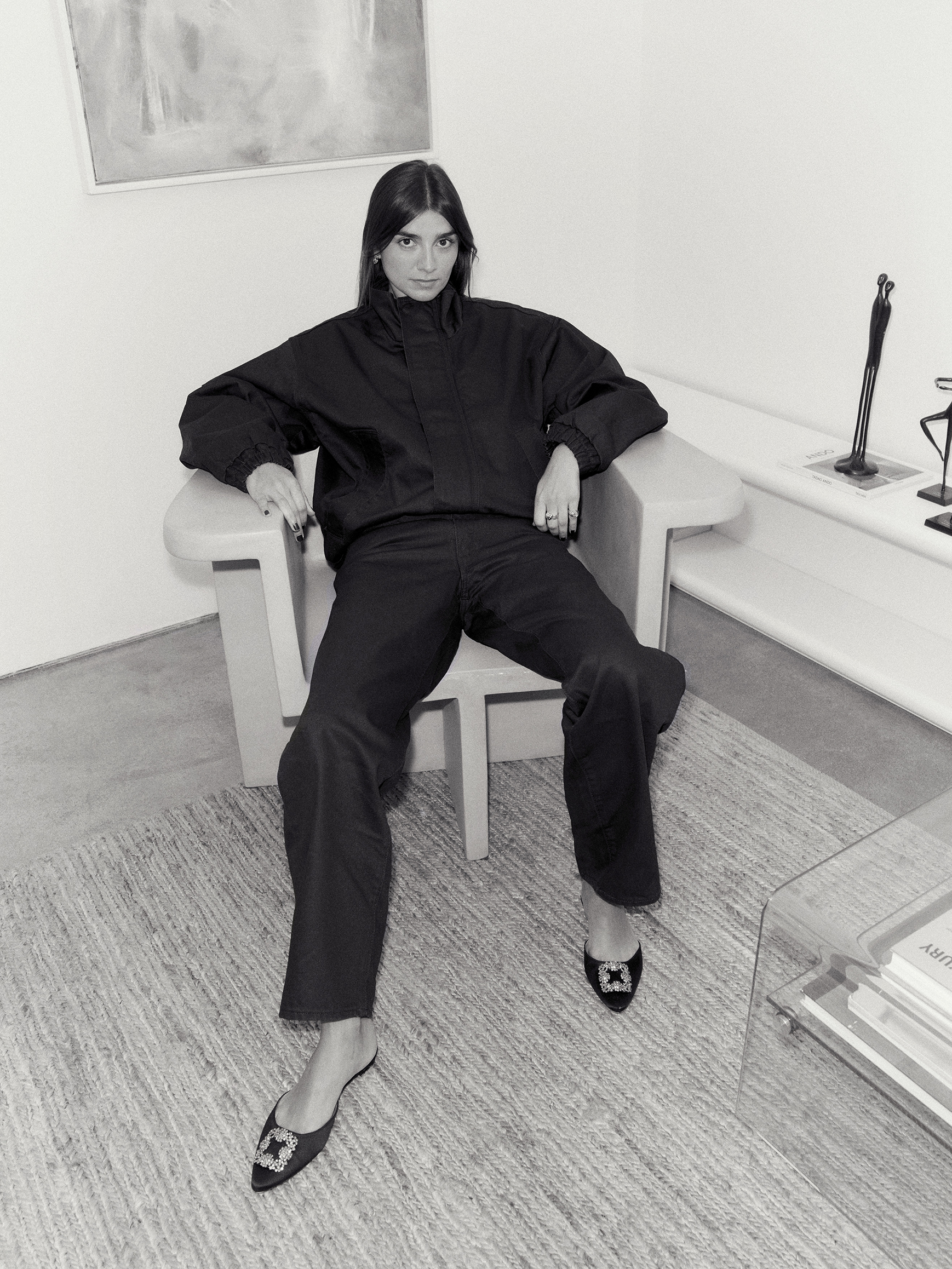
Juliana Salazar wears the Highland Park Jacket and 578 Baggy Jeans paired with her signature sparkly shoes. Photography by Georgia Devey Smith. Courtesy of HURS.
Some things never go out of style because they speak to something fundamental. What do you think your work and the clothes you choose to wear have in common in that regard?
I think practicality and functionality. My work is pretty straightforward. For example, I never really did editorial work. That’s just not me. While I appreciate it and I'm definitely inspired by it, it's not how I think or how I get dressed. I'm a very practical and straightforward person and I think everything needs to have a function. I just want my work to do what it's supposed to do and speak for itself.
It's not about selling a dream. But I think that's quite special in womenswear. In menswear you see that a lot where the styling feels more grounded in real life. It's more leaning into what you pair it with that makes it culturally relevant. I think you're very good at that and still making it feel desirable, luxurious, interesting.
I think it goes back to not having a lot of money to shop with when I was growing up. Even though I love shopping, if someone’s spending money, to me, it has to be truly worth it. Something I’m wearing often. Practical. If I'm spending money, it needs to be on something that's not ever frivolous. Even though I think my idea of frivolous is very different to most. But I’m never buying something that’s just sitting in my closet.
What's the one thing you always carry with you?
I always try to be open-minded. If I'm thinking about it figuratively. Unfortunately I always have my phone and headphones. Headphones are a big one. I used to be a person who, if I forgot my headphones at home, I would turn around to go get them. I was always listening to music and then I realized even if I'm enjoying it at the end of the day, it's still noise. I now have way more quiet time. My brain needs space to process things. A lot of times I'm walking around with headphones in and nothing's playing.
Earlier we talked about his digital world and there being so much and I think, you know, it's become a world that's so trend driven in a way, like micro trend driven and we see so much. How do you protect your point of view?
I consider myself lucky in the sense that I've always had a really strong conviction in myself. I know what I like and what I believe in. I'm not that impressionable. I think that naturally protects my point of view. As I've gotten older and stakes are higher, I realize it's important to have practices that ground me. Meditating, writing, reflecting all help me to make sense of the 100 tabs open in my brain and stay focused on what it is I'm working on and more connected to my intuition which I think is really the driver of my work and what fuels my views. You can get really caught up in busyness and then you end up being really distant from yourself and feeling not so sure about things.
What do you hope stands the test of time? Not just in fashion, but in the ideas you put out into the world?
An open-mindedness, curiosity and being able to have discourse. Being able to talk about things and think critically about them feels very rare nowadays. Respect is really important in that. On a human level, we're all on the same side. There's a lot of things going on in the world where people are pitted against each other, while I think ultimately most people want to just be able to live in peace and harmony. It's about hopefully remembering that we need each other to live and survive.
This interview has been edited and condensed for clarity.
Shaniqwa Jarvis on why photographs are beautiful liars, grief as a portal, and the moment she found her whole practice hiding in a childhood snapshot.