On the Teller of Tales
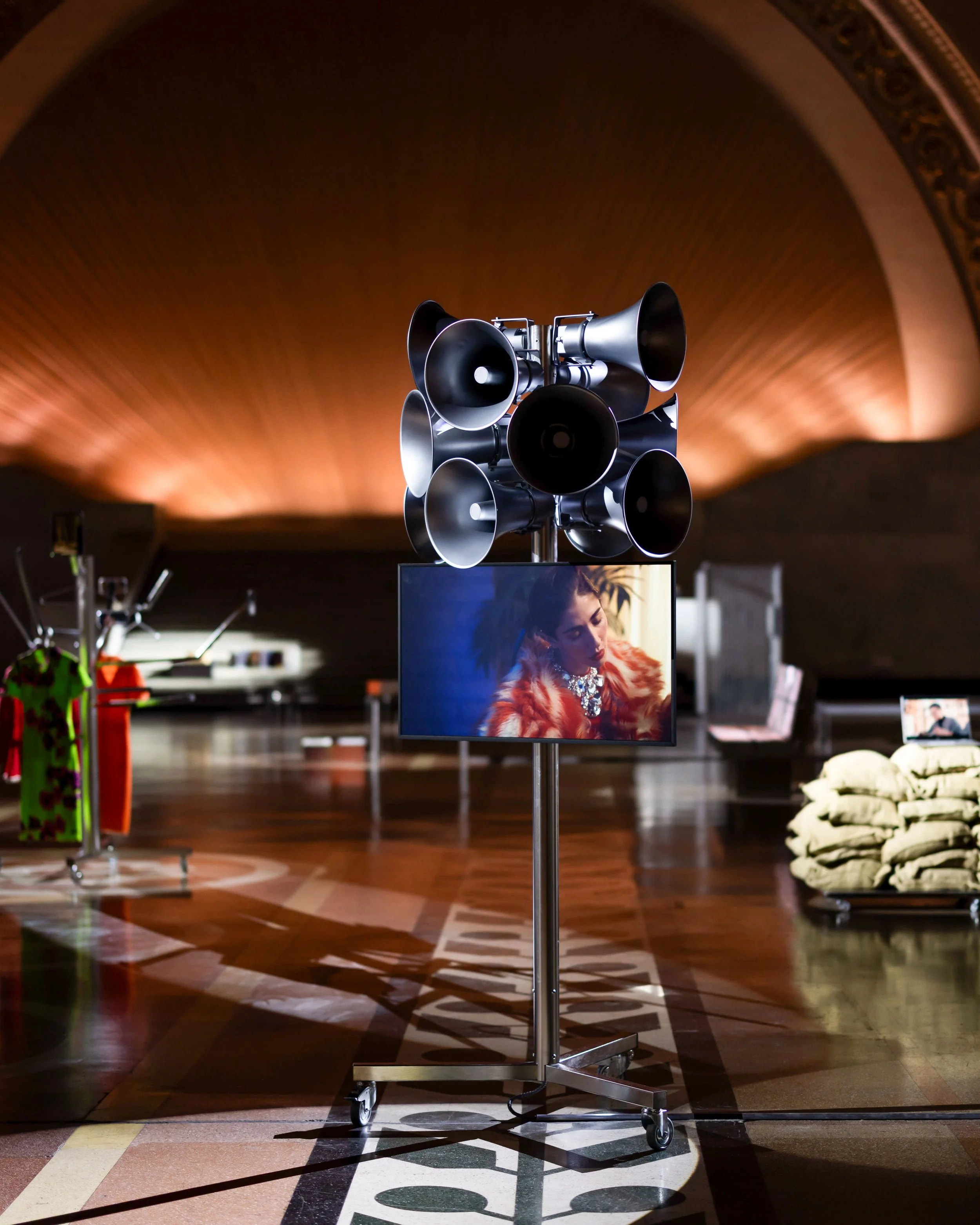
Miu Miu Tales & Tellers in Shanghai. Courtesy of Miu Miu.
On the Teller of Tales
By Bonnie Langedijk
The first storytellers were women. It is the oldest job we have held, older than any work that came with a title, a salary or the right to sign our names. Someone had to carry the story from one generation to the next: the genealogy, the recipe, the warning, the song. That someone was almost always a woman. She told the tale and kept it alive, and for just as long, the keeping has counted for the least.
To tell once meant to count. You hear it still in the bank teller, in all told, in telling the time. A tale was a tally, a record of what happened. The woman who told the stories kept the count. She held power: She was her family's memory and its record all at once.
Storytelling sits close to women's handwork, and you can hear it in the language. We spin a yarn. We follow a thread. We lose the plot, which is to drop a stitch. Text comes from the Latin for weaving, the same root as textile, because a story and a cloth get built the same way, separate threads pulled into something that becomes a whole. The women making the cloth were usually making the stories too, telling while their hands worked.
None of it earned much respect. When the fairy tale became a literary form in seventeenth-century Paris, it came through women. Marie-Catherine d'Aulnoy coined the phrase conte de fées, the fairy tale itself, and the women around her built the genre out of stories told aloud for centuries. Meanwhile, the word the culture chose for a story told by a woman is old wives' tale, meaning a thing not worth believing. The teller was everywhere and the telling never stopped, and her reward was to be filed under gossip. The keeper of the record became the source of the rumor. Call something women's work and you don't have to pay for it. Call it an old wives' tale and you don't have to believe it.
Anyone can put a story into the world now. CARRYING it faithfully, keeping it whole as it travels, is the harder part, and it still comes down to who you trust to hold it.
Today, we tell more stories than any generation before us. Every phone is a broadcast tower, the feed is wall-to-wall telling. The tools have changed completely; the thing that makes a story worth keeping has not. Anyone can put a story into the world now. Carrying it faithfully, keeping it whole as it travels, is the harder part, and it still comes down to who you trust to hold it. Miu Miu has built an exhibition around exactly that question, this summer, in Shanghai.
It’s called Tales & Tellers, conceived by Miuccia Prada herself alongside artist Goshka Macuga, curator Elvira Dyangani Ose and the director Fabio Cherstich. This June it reached its third version, after Paris and New York, because each city gets its own build: "a reimagining," Macuga says, "shaped by the context and character of a new city." The setup is plain. Performers move through the hall as custodians of stories, each carrying one character from Miu Miu Women's Tales, the house's long series of short films by women, while the film it came from plays nearby. You meet the story twice at once: on the screen and in the room in a living woman.
The piece takes the act we have buried, one woman carrying a story to the next person, and makes it the main event. Macuga keeps the teller and the tale tangled on purpose. "The storyteller is never outside the story," she says: you are shaped by what you carry, and you shape it in turn. "Performers, films, audiences, garments, voices," she says, "all become temporary custodians of meaning." A custodian keeps what someone else made, and the word carries authority, the dignity of being trusted with something that matters. That is the job women have done in the life of stories all along: the woman at the loom, the women in d'Aulnoy's salon, the grandmother who repeats a family story until the children can tell it after she is gone. Tales & Tellers takes that woman and puts her at the center, where she belongs.
The stories these custodians keep are worth knowing. Miu Miu Women's Tales is the longest-running commission of films by women anywhere: fifteen years, more than thirty films, added a couple at a time and many premiered at Venice, until the archive spanned continents and generations. Agnès Varda made one. So did Lucrecia Martel, Miranda July, Mati Diop, Alice Rohrwacher, Ava DuVernay, Chloë Sevigny. Each is one woman's account of femininity on her own terms. Together they make a chorus, an oral tradition rebuilt for now, holding what no single voice could hold alone.
This goes deeper than a fashion house being generous with its archive. We argue endlessly about authorship: whose name goes on the cover, who gets credited, who gets discovered twenty years too late and thanked once it is safely posthumous. Fine. Underneath that sits an older question we have barely touched. Who keeps the story matters as much as who first told it, the keeper has nearly always been a woman, and the keeping was dressed up as service for so long that we forgot it was power.
There is a great deal still to tell, and as ever, the women are keeping count.

Everyone is an expert now, and almost no one is. In her latest essay, Bonnie Langedijk asks how confidence came loose from competence, why we believe the ring light over the researcher, and whether real expertise can survive a culture that rewards speed over depth.