Notes on Instinct
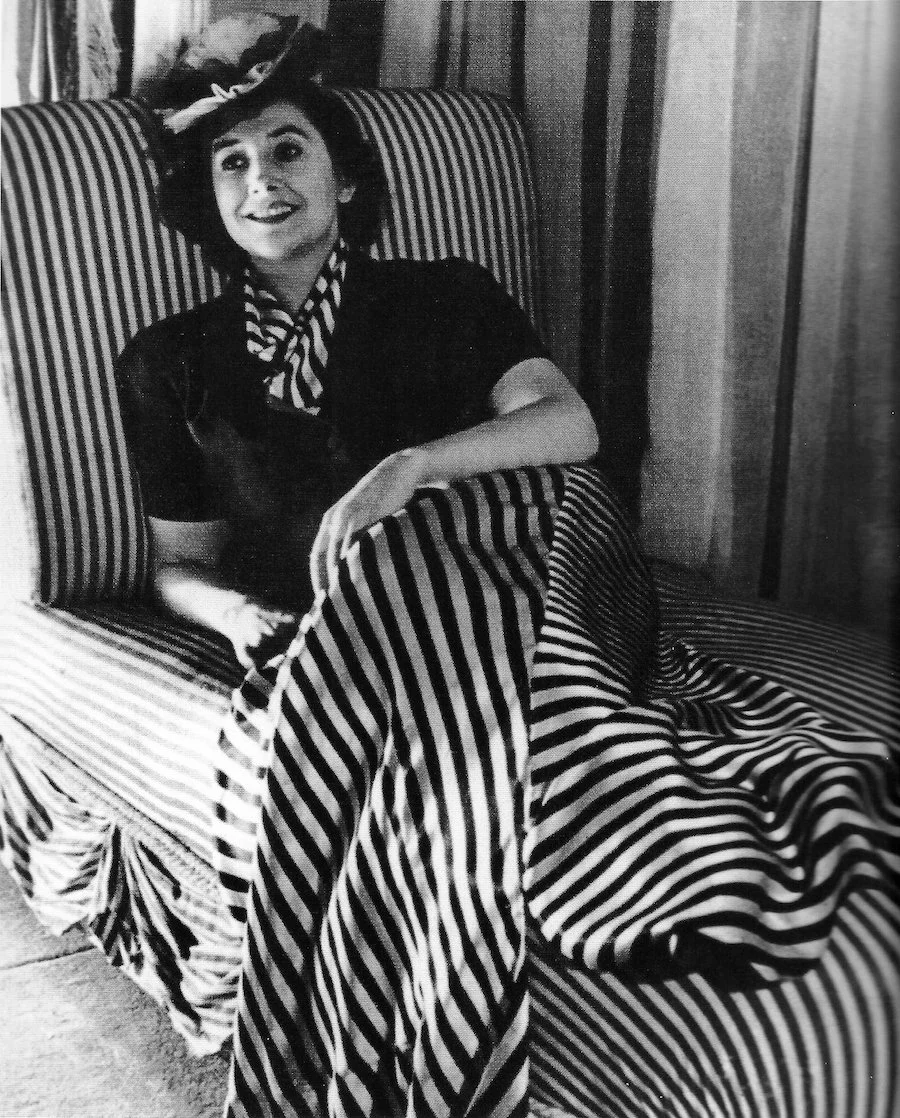
Madeleine Castang.
Notes on Instinct
An essay by Dahlia Hojeij Deleuze and Racha Gutierrez, the duo behind Studio Ebur, on Madeleine Castaing
In celebration of Making Space: Interior Design by Women by Phaidon—a groundbreaking survey of 250 leading interior designers spanning the twentieth and twenty-first centuries—we invited four women featured in the book to reflect on the visionaries who shaped their practice.
By Dahlia Hojeij Deleuze and Racha Gutierrez
There are certain personalities who intrigue more than they directly influence. Madeleine Castaing is one of them. Her path, her world, her way of escaping definition speak to us—not because we seek to replicate them, but because they resist replication.
Her influence extended far beyond the realm of decoration. She was close to Jean Cocteau—with whom she shared a deep connection, notably around the Villa Santo Sospir—and to the painter Chaïm Soutine, of whom she was one of the earliest patrons. Later, her intuitive approach would inspire creators like Yves Saint Laurent. Even today, her taste for poetic maximalism echoes in interiors that dare excess and emotion.
She wasn’t a decorator in the conventional sense. More of a self-taught intuitive—free, often countercurrent. What strikes us most about her is the way she placed instinct before rules, emotion before reason. She built her interiors like theater sets—vivid, layered, alive—following her impulses, even if it meant disrupting conventions. Her style, now highly recognizable, was built on deliberate contradictions: Empire furniture and leopard print, deep black and sky blue, humble objects and rare pieces.
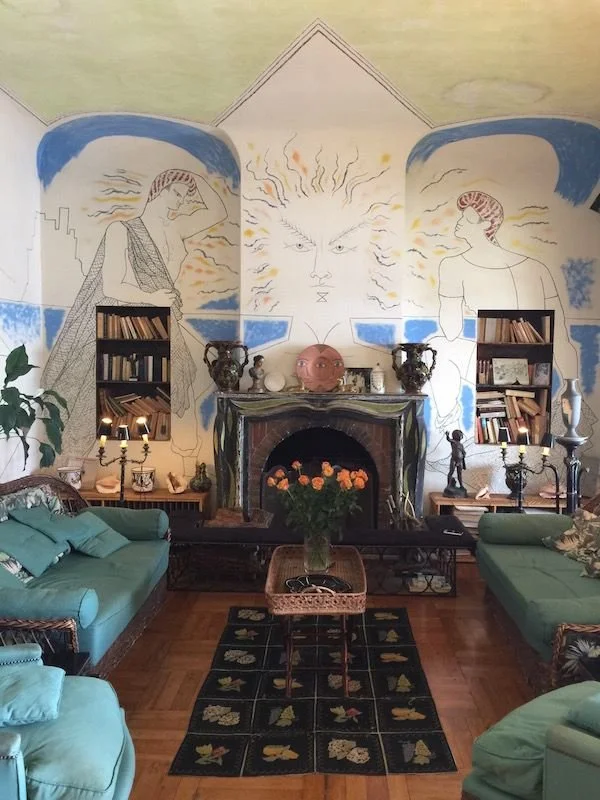
La Villa Santo-Sospir in Cap Ferrat, designed by Madeleine Castaing
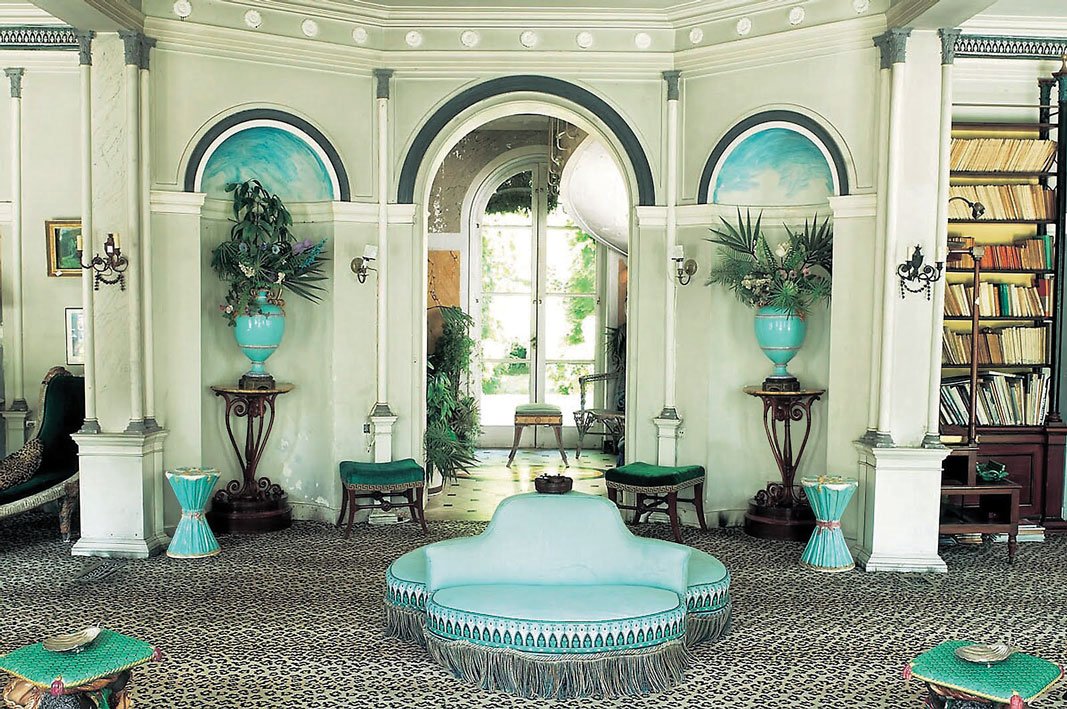
Maison de Lèves, the designer’s country estate near Chartres, designed by Madeleine Castaing.
What makes her work interesting isn’t so much the aesthetic itself—it’s the logic behind it: The intention to create a personal, lived-in, sincere world. Her house in Lèves, which we’ve only seen in photographs, perfectly embodies this approach. The rooms are dense, narrative, almost literary. Each element feels chosen with a gesture of pure instinct. For this home, she created an emblematic color—the now-famous “Castaing blue”—a luminous, vibrant turquoise that she paired with off-whites and deep blacks. She played boldly with contrasts, especially through the fabrics and wallpapers she developed in collaboration with her friend Francis Hamot. It’s not merely décor—she created an atmosphere.
Madeleine Castaing isn’t an absolute reference for us, but she opened a path—that of an interior that isn’t a statement, but a playground of memory, instinct, and intuition. In our own work, certain ideas resonate: The refusal of neutrality, the space left for feeling, the importance of narrative in a place. She reminds us that an interior shouldn’t only function or please—it should express something about the people who live there.
“She reminds us that an interior shouldn’t only FUNCTION or please—it should express something about the people who live there.”
Sometimes, in a moment of hesitation—a bold color, an unexpected mix—we think of figures like her. Not to imitate, but to remember that the mixing of styles can be a strength. It’s in the choice of a color for a wall, in the patterns of a surface, in the fabric we select for a vintage chair, in the shapes we dare to draw for a piece in our collection—those moments when we allow ourselves to follow instinct, even when it challenges what’s expected.
It’s also in the way we make objects from different periods and places speak to each other: An antique Syrian or Egyptian chair paired with a 17th-century Venetian mirror, a French Art Deco sconce next to a piece we designed. Objects that, through contrast, find harmony and tell a story together.
At a time when interiors often seem designed for screens, she reminds us that a space is not an image. It’s a narrative, a life, a beautiful and inhabited disorder. Her rejection of neutrality feels, today, almost subversive—and to us, profoundly liberating.
Everyone is an expert now, and almost no one is. In her latest essay, Bonnie Langedijk asks how confidence came loose from competence, why we believe the ring light over the researcher, and whether real expertise can survive a culture that rewards speed over depth.